
Buyer Value Option (BVO) vs Guaranteed Buyout (GBO) Home Sale Programs. How Do they Compare?

In the realm of corporate relocation, home sale assistance programs play a crucial role in easing the transition for employees and companies alike.

Among the relocation home sale programs, the most popular options are the Buyer Value Option (BVO) and the Guaranteed Buyout Option (GBO) programs.

Each option offering distinct advantages tailored to different needs, our blog will review:

BVO vs GBO Home Sale Benefit home sale with contract

Buyer Value Option
(BVO)

In a Buyer Value Option program (BVO), the employee is responsible for listing their home for sale, with marketing assistance from the Relocation Management Company (RMC). The employee must secure an outside buyer willing to purchase the home at a fair market value. A buyer value option program provides all the tax benefits to the employer and employee, but it depends on the employee securing an outside buyer. The employee is funded their equity, if the contract is deemed valid, based on the outside offer amount. The RMC closes the sale with the buyer at a future date. In a BVO home sale scenario, home appraisals are never ordered.

Buyer value options are a good way for an employee to oversee the entire process and ensure the best fit for their home. The risk of the home sale falling through falls onto the employee in this home sale option.

Guaranteed Buyout Option
(GBO)

What is a Guaranteed Buyout (GBO) program and how does it differ from a Buyer Value Option (BVO)?

Under a GBO program, the RMC orders two home appraisals and then averages the two to determine a guaranteed offer, with a fixed acceptance period. If the employee cannot sell their home on their own, the employer takes the home into inventory. The employer must maintain it until the company can resell it. This carries potential risks and additional costs for an employer.

A BVO home sale, on the other hand, minimizes this risk since the employer only purchases the home after the employee has secured an outside buyer. BVO and GBO home sale programs provide tax benefits to the employer and employee.

BVO Home Sale versus GBO Home Sale

When comparing the two, the choice between BVO and GBO depends largely on the company’s risk tolerance, market conditions, and the level of support they wish to provide to their employees.

BVO programs are cost-effective for companies but can place additional burdens on employees, making them more suitable for strong housing markets.

Conversely, GBO programs, while more expensive, offer greater assurance to employees, making them a preferred choice in uncertain markets or when a company prioritizes employee satisfaction and seamless relocations.
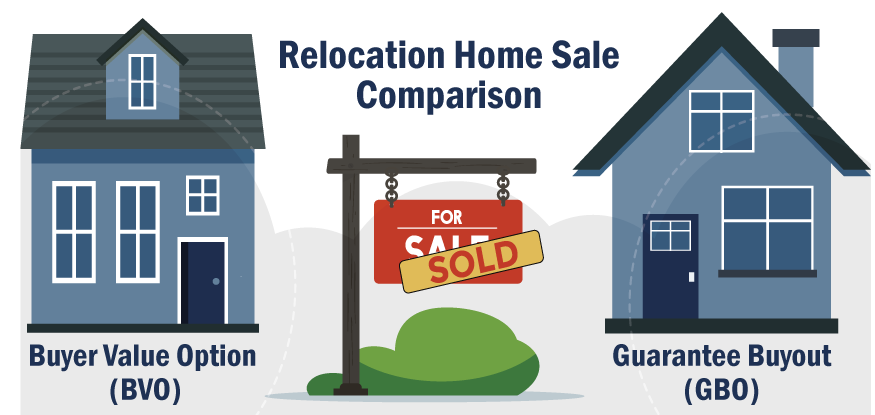
Relocation Home Sale Comparison reviews Buyer Value Option versus Guarantee Buyout Option

Here’s a side-by-side comparison of Buyer Value Option (BVO) and Guaranteed Buyout Option (GBO) home sale programs

Program Structure
Risk to Employee
Risk to Company
Home Sale Timeline
Employee Involvement
Financial Considerations
Market Impact
Flexibility
Appeal to Employees
Usage
Buyer Value Option (BVO)
Employee secures an outside buyer before the company purchases the home
Low risk if the home is sold quickly; however, the employee bears the risk if the market is slow
Lower financial risk since the company only purchases the home after an offer is secured
Typically, longer as the employee must find a buyer before the company purchase
High, as the employee is responsible for marketing and negotiating the sale of their home
Costs are generally lower for the company, but the process can be more stressful for the employee
The success of the BVO depends heavily on the current housing market
More flexible for companies that prefer to minimize upfront financial commitment
May be less attractive to employees due to potential delays and uncertainties
Preferred in stable or strong housing markets where homes are likely to sell quickly
Guaranteed Buyout Option (GBO)
Company provides a guaranteed buyout offer to the employee before listing
No risk to the employee as the company guarantees a buyout, regardless of market conditions
Higher financial risk for the company as they commit to buying the home regardless of market conditions
Generally faster, as the company buys the home directly if it doesn't sell within a set period
Lower, as the company takes over the home sale process after providing the buyout offer
Higher costs for the company due to the guaranteed purchase but provides more certainty and support for the employee
The GBO is less impacted by market conditions as the company assumes the risk
Less flexible due to the company’s financial commitment but provides more stability for employees
Generally, more appealing to employees due to the certainty and reduced personal risk
Often used in slower or volatile markets where securing a buyer may be difficult

Our countless years of BVO and GBO Home Sales experience can help you better navigate your journey.

This can include the range of tax implications, relocation variables, benefit payouts/amounts, and marketing work.

Let the experts at WHR Global help you with your BVO or GBO home sale relocation
and other global mobility program needs

WHR Global,a leader in global mobility, is an independent, full-service relocation management company with offices in the US, Switzerland, and Singapore. WHR strives to offer cost-effective relocation benefits without compromising empathy, ethics, or service

U.S. Domestic Relocation Cost Estimator

US Domestic Relocation Cost Estimator Icon

Interactive Repayment Agreement

Interactive Repayment Agreement Icon

Domestic Relocation Policy Designer

Domestic Relocation-Policy Designer icon

Relocation Benchmark Comparison

Relocation Benchmark Comparison icon

RFP – Relocation Request for Proposal Generator

Relocation Request for Proposal Generator

What is a Buyer Value Option (BVO) Home Sale Program?

A BVO home sale program is a program which is designed to help relocating employees sell their homes quickly and efficiently without the company taking ownership of the property.

According to WHR’s 2024 Global Mobility Benchmark, a BVO program remains one of the most competitive relocation offerings.

  • 60% of respondents offer home sale and/or purchase benefits.
    • Of those,
      • 59% offer BVOs to new hire non-executives
      • 78% offer BVOs to new hire executives
      • 67% offer BVOs to existing employee non-executives
      • 74% offer BVOs to existing employee executives

The best way to describe a BVO is in the context of
a traditional Guaranteed Buyout (GBO) program

Under a GBO, the relocation management company (RMC) orders two home appraisals and simply averages the two to determine a guaranteed offer.
As an example:

  • Appraiser A values a relocating employee’s home at $330,000
  • Appraiser B values the same home at $335,000
  • $332,500 is considered the “GBO”

The relocating employee then takes the offer of $332,500 and moves to their new location, unencumbered by their former home. In turn, the RMC sells the property on the
open market, and the employer is charged for all of the associated real estate expenses upon the conclusion of the sale.

The employer can treat the home sale costs as “business expenses,” so none of the expenses are considered income to the employee (for federal tax purposes).
This process is validated by the IRS in Revenue Ruling (2005-74), which specifically addresses this type of home sale program.

What is a Buyer Value Option (BVO)?

Essentially, BVO is very similar to a GBO, with the exception that with a BVO home sale program, no appraisals are completed. Instead, the buyout offer is based on a bona fide fair market offer received by the employee from a qualified third-party buyer. With BVO, the employee is responsible for listing their home for sale, and receives marketing assistance from the RMC.  

Once a contract is deemed valid, the RMC offers to buy the home from the employee at a price based on the outside sale price, and the employee is funded their equity based on this amount. The RMC will enter into a new listing agreement with the employee’s broker and proceed to close the transaction with the outside buyer while honoring all agreed terms and conditions. All home sale costs are treated in the same manner as with a GBO program.  

The BVO home sale program provides all the tax benefits to both the employer and employee. However, it is the responsibility of the employee to secure an outside buyer ready, willing, and able to purchase the property at a fair market value. 

Why should you offer your relocating employees a BVO?

    • Tax Savings: A properly structured BVO program that adheres to IRS requirements provides significant tax savings that benefit employees as well as employers.
    • Minimized Risk for Employees: Employees avoid the financial risk and stress of carrying two mortgages if they have to move before their home is sold.
    • Expedited Relocation: Employees can move to their new location more quickly, knowing that their home sale is being managed.
    • Cost Efficiency for Employers: Employers can manage relocation costs more effectively and help maintain employee productivity by reducing the stress and financial burden associated with home selling.

WHR Global provides the following
BVO support to help your employee
sell the home to an outside buyer:

    • Obtain two Broker Price Opinions (Broker Market Analyses)
    • Reconcile the two opinions of value
    • Suggest a listing price
    • Develop a comprehensive marketing strategy
    • Obtain pictures of the home
    • Provide tips to paint, declutter, etc.
    • Assist with Realtor selection
    • Obtain weekly feedback from Realtor
    • Assist in contract negotiation

Be aware: From a cost standpoint, when selling a home, the following expenditures are typical in a home sale transaction. 

When selling a home, there are several expenditures in a typical home sale transaction
  • Real Estate Commissions
  • Recording Fees
  • Transfer Taxes
  • Title Expenses
  • Notary
  • Escrow Fees
  • Seller Concessions
  • Repairs
  • Inspections
  • Miscellaneous

A Buyer Value Option home sale program is a valuable tool for companies looking to support their relocating employees. By assisting with the home sale process, companies can alleviate a significant source of stress for their employees, ensuring a smoother transition and enhancing overall job satisfaction.

For the company, this can translate into higher retention rates, more successful relocations, and a stronger ability to attract top talent. 

Ready to learn more about our move management services?

U.S. Domestic Relocation Cost Estimator

US Domestic Relocation Cost Estimator Icon

Interactive Repayment Agreement

Interactive Repayment Agreement Icon

Domestic Relocation Policy Designer

Domestic Relocation-Policy Designer icon

Relocation Benchmark Comparison

Relocation Benchmark Comparison icon

RFP – Relocation Request for Proposal Generator

Relocation Request for Proposal Generator

Discard & Donate Services

A Finnish Proverb says, “Happiness is a place between too little and too much.”

For many longtime homeowners, the shift to “too much” can occur without even realizing it. An accumulation of “stuff” over the years, busy schedules, and simply no time to finally organize the basement, attic, or garage….

This can all lead to an overwhelming task when homeowners are faced with moving to a new location.

Many homeowners resign to packing up all of their belongings and hoping to find the time to sort and discard while unpacking. But, there is a better way!

Discard & Donate

Discard & Donate professionals help sort, organize, and remove items prior to a move. Taking this time upfront enhances the marketability of a home during showings, reduces the overall cost of a move, and helps homeowners settle into their new homes more quickly. Not to mention, Discard & Donate also reduces transferees’ stress levels by providing part consultants, part coordinators, and part hard workers to support your employees and their families.

Global Mobility ESG

ESG Considerations

The environmental impact of sorting, discarding, or donating is also significant. Some movers calculate the number of trees saved on each move by eliminating cardboard and packing material. This is in addition to fuel savings and repurposing items through donation instead of sending them off to a landfill.

Not all household goods shipments are created equal, in terms of carbon emissions. In fact, the carbon footprint of air shipments is disproportionately high compared to other transportation modes, making it imperative for businesses and global mobility programs to seek sustainable alternatives; This includes preventing the item from ever being shipped by leveraging Discard & Donate. 

How the Service Works

Relocation management companies (RMCs) like WHR Global work with these Discard & Donate providers to aid employees, families, and their employers. The homeowner first completes a needs assessment with the provider to determine the scope of services needed. They can arrange for unwanted items to be picked up and donated to charity. Any goods that are unable to be donated will be taken by the provider to the appropriate waste removal site.

When determining which household items to keep, discard, or donate, it’s critical for relocating employees to ask themselves the following questions:

  1. Do you use the item regularly?
  2. Does it have sentimental value?
  3. Are you saving it “just in case?”
  4. Do you have more than one?
  5. Can you easily replace it in the destination?

The Cost

Pricing for Discard & Donate is determined by the amount of goods discarded or donated. However, if you — the employer — are paying for the move, the service fee is nominal compared to the transportation savings (with an additional $.65 per lb. of savings remaining).

Example: Remove 2,000 lbs. of household goods

Standard shipping cost:                   $2,400
Discard & Donate fee:                       –$1,100 
Savings on one shipment:                $1,300

Conclusion

Just remember: “The more things you own, the more they own you.” Relocating employees have enough concerns, including housing, timelines, cost of living, and more. 

Contact us to find out more about how Discard & Donate services can help relocating employees declutter, be happy in their new homes, and save your company money in the move process.

Providing Mortgage Support to Transferring Employees in Today’s Housing Market

As companies compete for talent, it’s important that your organization offers the right mortgage support to transferring employees. Whether it’s a new candidate or an existing employee, don’t lose talent because your organization isn’t offering the same or more support than your competitors. Given the current housing market conditions, it’s especially important to evaluate mortgage support so that contracts are not canceled.

According to a CNBC article, “Amid higher interest rates and a softening housing market, home buyers are continuing to back out of purchase contracts at an elevated rate. About 64,000 home-purchase agreements were canceled in August, according to a new report from Redfin. That’s equal to 15.2% of home contracts initiated during the month and similar to the 15.5% canceled in July. A year ago, the share was 12.1%.”

Rising interest rates could also have a negative impact on your transferees and their willingness or ability to relocate. When some employees are finally ready to go under contract and lock in their mortgage rates, the rates could be much higher than they were when they got pre-approved or when they received an accepted offer. This could also cause a canceled contract if the new rate is unaffordable.

“Data from the National Association of Realtors shows that housing affordability has plummeted by 29% over the last year – marking the steepest annual decline on record. The downturn is attributed to rapid mortgage rate and home price growth that has significantly quelled affordability. That’s because buyers of a median-priced home are now facing monthly mortgage payments that are more than $400 higher than they were in 2021,” according to a Business Insider article.

There are many ways that your organization can help transferring employees with mortgages. Below we’ve outlined a host of options that WHR Global (WHR) can facilitate through our preferred mortgage provider network.

Mortgage Interest Differential Assistance (MIDA)

MIDA helps employees when mortgage interest rates are high by easing the gap between current market rates and the lower rates that employees have on their current mortgage. This is not to be confused with a sliding scale (explained below), or a standard 1% loan origination/loan discount benefit because those benefits are applied regardless of the interest rate. The MIDA can be paid as a direct mortgage subsidy through the mortgage company. The MIDA benefit is determined by factoring the lower amount of either the transferee’s current outstanding loan balance (rounded up to the nearest $1,000) or the new mortgage amount. The difference between their current interest rate and the new (higher) mortgage interest rate, for similar products, (i.e., 30-year fixed rate to 30-year fixed rate), and multiplying the difference by the qualifying amount:

An Example from a WHR Supplier Partner, Rocket Mortgage

3.00% Old Interest Rate
5.00% New Interest Rate
2.00% Interest Rate Differential X $400,000 Current Loan Balance (Old Mortgage)
$8K is the yearly mortgage interest differential (.02 x $400K = $8K)

Payout Example
Year 1: $8K x 100% = $8K Total, or $666.66/month ($8K/12 = $666.66)

According to Rocket Mortgage, “The above is just an example. You can design the overall MIDA structure to what works best with your company culture and relocation program needs. For example, you can pay the full MIDA amount in year one only, adjust the percentages each year, or lengthen the term of the MIDA payment, etc.”

Interest-Based Mortgage Subsidy

This option slowly increases the transferee’s interest rate over time. Your organization pays the difference between the current note and the lower subsidized rate. Every year, the employee’s responsibility will increase by a 1% higher subsidized rate. This helps transferees transition into the higher mortgage payment. It can be applied toward principal and/or interest. If the subsidy is interest-based, your organization’s payout is dependent on the loan amount (which may be variable). To avoid this variable, some companies define a fixed dollar amount.

Dollar-Driven Mortgage Subsidy

When an employee is moving to a higher cost of living area (not due to higher interest rates), this option provides a pre-determined dollar amount based on the employee’s level. The amount can even be determined pre-move and pre-home selection. It can be applied 100% to principal and/or interest, based on the employer’s policy. It cannot exceed the monthly mortgage payment amount. Sometimes the subsidy is payable over a period of time that the employer chooses, 3 years, e.g. The payment is made directly to the mortgage company and applied against the employee’s mortgage payment.

Sliding Scale: Buying Down Points

A one-time expense used to permanently buy down the interest rate on a new home. This is especially helpful when interest rates are rising. Your organization will designate at what rate the scale starts and what mortgage discount points will be covered for each interval of the scale. Mortgage points are prepaid interest paid upfront in exchange for a lower interest rate and lower monthly payments.

Loan Discount Points (points) – Fees used to buy down the interest rate at the time of origination for the life of the loan. Points are calculated as a percentage of a loan amount. E.g., 1 point is 1% of the loan amount. One discount point does not equal a 1% reduction in interest rate. The value of a loan discount points is based on market conditions.

Example

Let’s say the current market interest rates on a 30-year fixed rate loan is 5.25%, the transferee would be eligible for 1 loan discount point based on the example sliding scale below based on $400K loan amount: 

  • 0% – 4.99% = 0 pts
  • 5% – 5.49% = 1 pts = $4K
  • 50% – 5.99% = 1.5 pts = $6K

Buying Down Points Example on a $200K loan

0 points (4.5% APR*)
1 point (4.25% APR*)
2 points (4% APR*)
Costs per Point(s)
$0
$2000
$4000
Employee's Monthly Payment
$1,013.37
$983.88
$954.83
Total Employee Savings on a 30-year loan
N/A
$10,616.40
$21,074.40

Other Possible Ways to Help the Transferee

$3K credit: Employer to cover the closing, or the credit could be used for escrow, or used to buy down the interest rate.

“It’s so important to provide the right benefits to transferees, including mortgage support. As an organization, you don’t want to lose a valuable employee or a potential new candidate to another company.”

Ben Koceja

Client Services Manager, WHR Global (WHR)

As a Relocation Management Company, WHR can provide your employees with our pre-approved network of mortgage providers.

Contact Us!

Top 5 Destination Services for Homeowners

When relocating an existing homeowner, there are many things to keep in mind (such as selling their home, finding a new home, moving a home’s worth of goods, and usually supporting a whole family versus one relocating employee). Here are five important benefits you should provide your relocating homeowners to make sure they settle into their new destination without any hiccups.
<img alt="destination services">,<img alt="temporary living">,<img alt="employee relocation">

1. Home Purchase Assistance

One of the first things a relocating employee asks themselves is, Where will I live? This is where Home Purchase Assistance comes in. Home Purchase Assistance should include in-depth counseling—addressing relocating employees’ needs and concerns in their new location. There are specialists at relocation management companies trained to act as an objective advocate for the transferring family throughout a home search process, reviewing the real estate agent responsibilities with respect to buying a property in the destination location. This should also include reviewing different real estate “agency” representations; employee housing requirements and time limitations, including transfer date, projected move date, preferred area, community amenities, price range, size, and style of desired property; availability; commuting logistics; and any unique requirements the transferring family may have. At WHR Group, we employ Relocation Counselors who are licensed real estate salespeople, meaning true market knowledge throughout the home purchase process.

2. Rental Assistance

We understand that owning a home isn’t for everyone, especially if this relocation is not long-term for the existing homeowner. Homeowners should also receive the option to rent in their new location, and this Rental Assistance should be personalized to the relocating employee’s unique needs. Make sure your relocation company offers renters the following helpful services:
  • Area Tours: When a local/on-the-ground agent provides a “show off” or area tour to the prospective renter. This allows the renter to see various neighborhoods that could work for them; the best areas for entertainment, shopping, and dining; plus access points to public transport.
  • Guided Tours: Following a thorough needs assessment, a local agent is assigned to locate properties that best fit the renter’s needs, until the perfect place is found. Additional support for lease negotiation and financing hurdles is provided.
  • Self-Guided Tours: The renter receives online, detailed access to available rental units following a thorough needs assessment.
  • Other: Guidance for obtaining a new driver’s license and finding local grocery stores and banking institutions for opening new accounts.

3. Network Support

At WHR Group, we manage a network of over 40,000 real estate agents. All agents are interviewed and must meet certain quality criteria before inclusion in our network. Based on the relocating employee’s particular requirements, their Relocation Counselor will select a real estate agent (or agents, depending on the complexity of the market area) in the destination location to assist the employee in finding suitable housing. The Relocation Counselor furnishes the selected agent with a complete profile of the employee’s personal housing needs and community preferences. The agent will then provide an introductory packet of information about the destination area, oftentimes containing data regarding representative communities and home price ranges, community profiles, maps, state and local income tax facts, school district data, available medical services, public transportation schedules, driver’s license and registration information, moving tips, local sites and attractions, dining and entertainment guides, recreation guides, and other pertinent information on the new location.

4. Temporary Living

Corporate relocation isn’t always long-term, which is why we maintain a network of corporate or temporary housing providers and hotel chains. Offering this service allows short-term transferees to feel at home anywhere, no matter for how long. Your relocation provider should work with temporary housing providers that, at a minimum, conduct unit inspections 24 hours prior to employee arrival, supply an inspection sheet for every unit with recent photos, and provide a phone number for 24/7 emergency assistance.

5. Area Tours

Area tours are usually conducted by the selected real estate agent but coordinated by the Relocation Counselor. Based on individual lifestyle information and housing preference criteria, the destination area agent will provide the following for the relocating employee:
  • Review desirable and affordable communities and screen the available homes within a commuting radius to the new location. The Relocation Counselor will arrange for the destination agent to contact the employee and familiarize them with more detailed information about the local area.
  • The destination agent will prepare a complete home-hunting itinerary and schedule of available properties for the employee so that the transferring family is able to get acquainted with the area and see available homes on a timetable that meets their needs.
  • When a suitable home is located, the Relocation Counselor ensures that the destination agent assists the employee in preparing the proper contracts and negotiates the home purchase according to applicable laws and regulations regarding relocation home sales.
  • To enable a more informed decision by the employee, before making an offer to purchase a property, the Relocation Counselor will arrange for the destination agent to provide the employee with historical data on comparable home sale prices for the area within the previous three years.