6 Ways to Align Global Mobility & Talent Acquisition

Has your organization strategically aligned your global mobility and talent acquisition stakeholders? Or do your teams feel siloed with different priorities and understandings? Read below to discover 6 ways to align global mobility and talent acquisition teams, including insights from Reda Belabed, GMS, a global mobility and immigration leader previously with Honeywell and General Electric, and WHR Global’s Strategic Initiatives Manager, Sean Thrun.

You’re not alone if you feel your global mobility and talent acquisition teams aren’t working towards the same objectives! Fortunately, there are several common-sense steps you can take to improve your talent mobility and ensure these stakeholders are working as a cohesive team.

When global mobility and talent acquisition teams are aligned, your highly specialized employees are hired quickly and compliantly.

1. Distribute “How To” Relocation Guides to your Global Mobility and Talent Acquisition Teams for Core Locations

Distribute “How To” guides to your talent acquisition and global mobility teams. These should be mission-critical things they must know for your company’s core locations, including immigration, tax, and recommended relocation support. For example:

      • Your company regularly hires executives to work in your Netherlands Global Center of Excellence. Are your teams applying for the Netherlands’ 30% ruling? Is your talent acquisition team responsible for ensuring each applicant meets the 30% ruling’s requirements before presenting the job offer? For example, your talent acquisition representative must ensure the candidate has specific expertise, is recruited greater than 150 km from the Netherlands border, and more.
      • Due to the highly specialized nature of your business, you are recruiting internal and external candidates for a position in the U.S. Is your talent acquisition team familiar with U.S. visa types, such as the L-1 visa for intracompany transfers, or the H-1B visa for specialty occupations? Your talent acquisition teams should know the basic requirements for each visa type before attempting to source foreign talent.
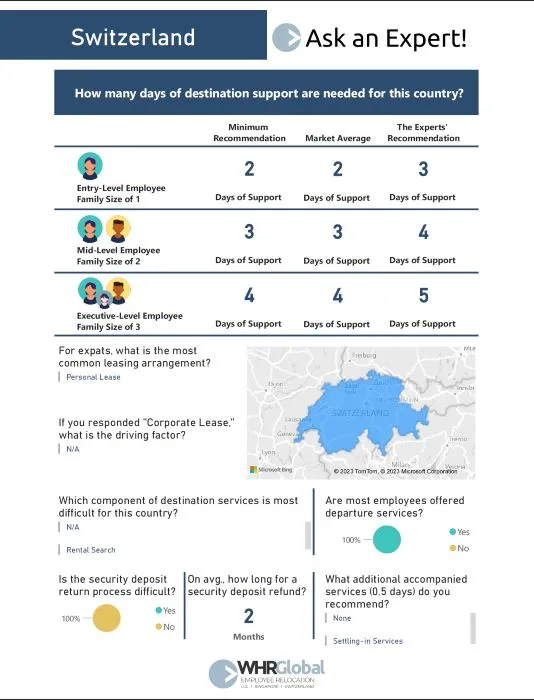
      • Your RMC should proactively guide the level of relocation support needed by country for your core locations. For example, this 2023 Destination Services Benchmark Report indicates the minimum, average, and recommended level of destination support by country, family size, and employee level. The report also indicates if leases should be personal or corporate, how long it takes to receive a security deposit return, and which components are most challenging.
WHR Global Ask an Expert Destination Services Benchmarking Switzerland

2. Review Talent Acquisition Metrics such as Time-To-Fill

Unfortunately, TA (talent acquisition) is not only measured based on the volume/quality of positions filled but mostly on the Time-To-Fill (TTF) which often widens critical gaps between the organizational needs, candidates’ experience and the tough reality of compliance.

I’ve implemented a cross-functional pre-assessment process for what I called “Immigration Hire-ability”, where permissible by law. Where it has been applied, I’m quite comfortable with the level of partnership it managed to increase between the two functions (and ultimately mitigate the risks of “bad hires”). In other places, Data Privacy regulations along with Fair-Employment Practices appeared to be hurdles to the implementation. There’s not a lot of flexibility when it comes to Labor and Employment, through Works Councils and the likes and it’s really been a challenge.

One of the plasters we have been focused on in these instances is increased (and repeated) training and education sessions with the recruiters to get them up-to-speed with “what they need to look out for/how to identify red flags” and review the overall communication strategy (up to offer accept), to enable all stakeholders to have a better understanding of the potential risks inherent to the hiring of Candidates on an immigration status and/or sponsorship requirements and responsibilities (incl. cost, timelines, immigration lifecycles, as well as talent management strategies).

I guess we’re all progressing but there’s still a long way before we can say we’re comfortable with the level of collaboration and partnership, with a 100% Candidate satisfaction, an improved TTF metric and a satisfactory pre-hire Immigration Compliance assessment.

Reda Belabed, GMS

Global Mobility & Immigration Leader, Previously at Honeywell & General Electric

3. Implement Pre-Acceptance Checkpoints to Increase Success Rates

As alluded to above, mobility programs can greatly increase assignment acceptance and success rates by implementing various pre-acceptance checkpoints.

      • Retain the services of a reputable tax firm. In addition to country briefings for assignees, they can provide invaluable guidance to talent acquisition teams. At a minimum, ensure your talent acquisition teams are familiar with the concepts of tax assistance, equalization, and totalization agreements. Provide pre-acceptance tax briefings to all foreign applicants.
      • For country-specific tax briefings, applicants should be aware of their options before accepting the position, as any misunderstandings can greatly increase the risk of a failed relocation or assignment. Assignees (especially those within executive or director-level positions) may have complicated investment portfolios of stocks, stock options, bonds, real estate holdings, precious metals such as gold, etc. The employee’s options will vary greatly depending on the location, citizenship(s), and relocation type (permanent transfer, long-term assignment, short-term assignment, commuter, business traveler). 
      • As mentioned above in step 2, build your own cross-functional pre-assessment process (a.k.a. immigration hire-ability guide) where the law permits. However, you should be cognizant of challenging jurisdictions such as the United States and European Union, as further detailed by Reda Belabed:

    Countries like the US where questions can be limited to “will you or in the future require sponsorship” and other EU countries where requesting personal information/data can be considered as PII and a hinderance to fair employment practices/discrimination at hiring. Geographies like the Middle East (GCC, in particular) are more open to these assessments.

    Authorities having a long history of foreign and diverse workforce tend to allow/promote the recourse to hireability checks based on sponsorship requirements but also advocating for more transparency in terms of “quotas”. Not that nationality quotas are something to condone, but the transparency around it helps the pre-determination of feasibility – instead of engaging with candidates through the offer stages only to discover it may not be possible. From an organizational standpoint, the process is quite transparent and streamlined.

    Reda Belabed, GMS

    Global Mobility & Immigration Leader, Previously at Honeywell & General Electric

    4. Pre-decision Calls through your Relocation Management Company (RMC)

    Your global mobility team and RMC may also choose to implement pre-decision calls. In relocation management, pre-decision calls ensure that the candidate understands the relocation package they’ll be receiving. However, they’re also an opportunity for your RMC to promote your company and benefits package and alleviate any concerns the employee or family may have.

    Pre-decision calls also prevent discrepancies or misunderstandings once the employee accepts the offer and begins the relocation process. For example, after the pre-decision call, the employee knows exactly which package they will receive, how much each relocation allowance will be, and more. Oftentimes, there is a disconnect between the relocation package quoted by a talent acquisition or HR business partner and the relocation package implemented by the RMC. This may boil down to human error or someone operating on an old/outdated policy. These discrepancies can be minimized when the RMC explains the relocation package pre-decision and implements the relocation package post-acceptance

    Align Global Mobility & Talent Acquisition

    5. Optimize Your HRIS for Maximum Talent Mobility

    Your organization can maximize talent mobility by creating custom fields, objects, and reporting in your HRIS (human resources information system). For example, in ADP, your organization can build and manage a talent pool of applicants willing to relocate for open positions. However, your organization shouldn’t overlook existing employees willing to relocate for an intracompany transfer. Existing employees should understand your products, services, and expectations, reducing hiring and training costs. 

    According to SHRM benchmarking, the average cost of hiring an executive is $28,329 USD. However, many employers estimate that the total cost to hire a new employee can be three to four times the position’s salary. This is a combination of hard costs, such as recruiters, and soft costs, such as the time it takes for department leaders and managers to support the hiring and training process.

    Instead of sourcing new candidates from scratch, speak with your IT department about adding custom fields and objects and reporting to your HRIS system. Then, existing employees can indicate in their HR profile if they’re willing to relocate for a new position. Within the custom reporting, you can also add filters to narrow your talent pool to high-performing employees who are willing to relocate, combined with past performance reviews already loaded in the HRIS.

    Online recruitment application and one day specialist search service concept with man finger on virtual digital interface with personal cards with rating

    6. Conduct Regular Training Sessions With Talent Acquisition Teams

    Regular training sessions ensure your talent acquisition teams have access to the same systems, resources, and responses to questions that are frequently asked by candidates pre and post-acceptance. Training sessions also provide new talent acquisition team members an opportunity to learn more about the mobility packages your employees are receiving and reinforce the message that all talent acquisition teams should follow the same standardized processes.

    Relocation management companies regularly arrange training sessions with talent acquisition teams and relevant stakeholders to improve talent mobility. These training sessions can include:

        • On-site training sessions from the relocation management company for mobility, TA, and HR teams. Depending on the size of your mobility program, your RMC may conduct these training sessions for free or just request your company to cover hotel and travel costs (depending on the distance and duration).
        • Virtual webinar-style training sessions from the RMC.
        • Country or region-specific training for your organization’s key locations, or locations presenting unique difficulties.
        • Insights from destination services providers (DSPs) and rental agents around market updates, cultural norms, and best practices.
        • Guidance from immigration firms on red flags, quotas, estimated timelines, minimum salaries, labor market testing requirements, and more.

    We have achieved significant success in transitioning regional structures to a centralized global mobility program by conducting regular training sessions with talent acquisition leaders. These sessions primarily focus on journey maps and crucial considerations throughout the process. By actively involving regional TA stakeholders in discussions about mobility benefits and desired outcomes, we have observed a noticeable increase in their willingness to adopt standardized processes.

    Sean Thrun

    Strategic Initiatives Manager, WHR Global


    In conclusion, aligning global mobility and talent acquisition teams is crucial for organizations to ensure efficient hiring and successful talent mobility. By distributing relocation guides, reviewing talent acquisition metrics, implementing pre-acceptance checkpoints, conducting pre-decision calls, optimizing HRIS systems, and conducting regular training sessions, organizations can foster collaboration and enhance the effectiveness of these teams. Achieving alignment leads to the swift and compliant hiring of specialized employees, reduces risks, improves time-to-fill metrics, and ultimately enhances overall candidate satisfaction and immigration compliance. Continued efforts and investment in aligning these teams will contribute to a more streamlined and successful talent acquisition process.


    Six Tips for Relocating Employees that Attract & Retain Talent

    Employee relocations or even temporary assignments to a new location can be complicated and stressful for your employees. You’re not just shifting employees from one location to another, you’re uprooting them from their community, friends, extended family, and everything familiar. You’re also moving their partner, children, and pets. As an employer, you have a huge responsibility when moving an employee and family to a new city, state, or even country. It’s very important that the employee’s move experience is as stress-free as possible. Employee relocations handled correctly will help your organization attract and retain valuable top talent.

    1. Consider Employees’ Emotional & Mental Health: Meet their Needs

    If a relocation is not handled well, the employer risks losing the employee to another company – someone whom your company may have already invested time and money into. If you want to attract and retain top talent, and you consider your employees one of your most valuable assets, remember to address more than just relocation costs and logistics. Taking care of an employee’s emotional health will pay out for years to come. Is your relocation policy meeting your employees’ needs? The right policy helps to reduce transferee stress so that employees can focus on working in their new location.

    Do:

    • Give employees time off to assimilate in their new location. Many organizations give employees 2-3 paid days off.
    • Provide support to transferees’ families (spousal assistance, language lessons).
    • Gather employee post-relocation feedback to make future policy decisions (WHR Global sends out a 1-year post-relocation survey).
    • Have your Relocation Management Company (RMC) help with logistics including visas, shipping, customs fees and clearances, transportation, legal issues, and more.

    The stress of moving might impact an employee’s mental health and subsequently, engagement with their employer. Transferees and their families may face a host of potential emotional and mental tolls from a relocation. According to an article in Employee Benefit News, “When it comes to employee relocation, most organizations focus on the nuts and bolts, thinking strategically about the costs associated with the move and what will be the most affordable option to get their people from point A to point B. It makes sense from a business perspective, but it’s not how to make a relocation successful. Employers must remember they are moving people, not just boxes. Any time you deal with people, you need to adopt a human-centered approach. While you’re helping them get their belongings from one place to the next, they’re dealing with switching insurances, licenses, and addresses. If they have a family, they need to enroll their children in new schools, find doctors, and a new job for their spouse or partner. On top of that, they might be dealing with some negative emotions from their family, unhappy with the move. All of this can influence how your employee feels about their new position and how they assimilate into their new role.”


    Be Aware:

    • If one or more family members are unhappy with the move and having trouble settling in, the stress could affect the employee too. The employee might be feeling distracted, disengaged, or unhappy, and they might even consider leaving the new role and moving back to their original location. Uprooting an entire family’s life and acclimating to a new community can be stressful.
    • If an employee becomes disengaged, productivity could decline. The transferring employee may be worried about whether the new job will work out. A tired, disengaged, or distracted employee’s attitude may be felt by other team members and affect team dynamics.
    • Employee stress associated with moving to a new location might also include concerns about a partner’s career, children’s education, learning new languages, cultural differences, selling their old home, leaving old coworkers behind, or concerns about the new destination’s real estate market or crime rates.

    “The Great Resignation is unprecedented; recruiters are competing against talent ready for a change and even talent that has been placed within the last two years. Employers will need to be strategic in their efforts to hire and retain.”

    Kimberley Uitz, SHRM-CP, GPHR

    WHR Global Human Resources Manager

    Do:

    Make sure you have a relocation policy that includes all potential support. The following list includes just some of the possible benefits to consider:

    • Immigration & Visa Support
    • Tax Assistance
    • Household Goods Move
    • Help Buying & Selling Homes, Finding Rentals
    • Language & Cultural Training
    • Medical Options (healthcare coverage, medical evacuation services)
    • Education Options (tuition reimbursement, tutoring)
    • Transportation Information
    • Utility Connections
    • Education Assistance
    • Site Visits/Area Orientation
    • Temporary Storage
    • Family Support
    • Ongoing Assignment Support
    • Destination Services
    • Temporary Housing
    • Driver’s License and Registration Information
    • Spousal/Partner Career Assistance


    2. Benchmark Relocation Policy Against the Competition

    Hopefully, your relocation policy is already part of your total rewards and talent management strategy. By benchmarking your policy against other companies, you will stay competitive in the war for talent. Make sure your policy provides a choice of offerings since relocation policies are wrapped into job offers. If you don’t benchmark against your competitors, you won’t know if your offerings are good or not. Are they subpar to what everyone else is offering? If you are hiring scientists, for example, and the talent is very specific and not easy to come by, you’ll want to make sure you’re competitive with salary, benefits, and your relocation policy. The right policy will help your company retain current employees and attract top prospective candidates. A weak relocation policy could have a negative impact on your recruiting and retention success rate. 

    At the same time, benchmarking will ensure you’re not giving away too much when none of your competitors are doing that. Benchmarking your policy against others shows you’re in line with the industry. Maybe you’re offering unnecessary benefits and eliminating those offerings could yield cost savings. It’s also important to look at your industry and other industries you compete with for talent.

    3. Compensate for Cost-of-Living Differences

    Some of your employees may be moving to an area with a lower cost of living and some may be moving to a much higher-cost destination. If higher costs exist, provide a limited-term cost of living allowance to bridge the financial gap. Options for payout could include monthly, quarterly, annually, or a one-time lump sum. Set an ending time for this benefit and decide whether the benefit will slowly decrease or taper. It is best to only offer this benefit to those employees moving to higher-cost destinations; if your employee is moving from one high-cost of living area to another, consider withholding this benefit. Often, employers will establish a threshold (typically a percentage), for the benefit. Other employers will identify specific areas and only offer the benefit to employees moving to predetermined locations such as Boston, Chicago city limits, New York City, San Francisco, Geneva, Paris, London, Singapore, and Shanghai, for example.

    4. Review your Relocation Policy

    Review your employee relocation policy annually or every couple of years, at the very longest. It’s an opportunity to pause and look at employee survey feedback, plus confirm any changes in your company culture, driving principles, core values, talent strategy, the industry, and your competition. Make sure you’re allocating the right amount of dollars to both transferees and organizational needs. It’s also important you’re not paying for unneeded or outdated benefits. Lastly, review the purpose of your relocation program. This is a time for you to make sure your policy is aligned with your key stakeholders (talent acquisition teams, recruiting teams, and HR business partners).

    To summarize, there are many benefits you’ll want to consider including in your relocation policy (not an all-inclusive list):

    • Home Sale (Guaranteed Buyout versus Buyer Value Option)
    • Direct Reimbursement
    • Policy Tiers vs Core Flex Benefits
    • Lump Sums (Lump Sum Only; Managed Lump Sum; Lump Sum in addition to other benefits)
    • Cost of Living Assistance (COLA)
    • Home Inspections (Major and/or Specialized)
    • Home Sale Bonuses
    • Loss on Sale
    • Rental Assistance/Lease Break Assistance
    • Destination Services (Temporary Housing, House Hunting Trips, Destination Closing Costs, Renter Destination Services)
    • Household Goods Movement (Vehicle Shipment; Temporary Storage)
    • Policy Exceptions


    5. Compensate Employees for Their Tax Burdens

    Tax Assistance & Tax Equalization

    If you’re competing for talent and your competitors are compensating for tax burdens and you are not, you could lose in the war for talent. By offering tax benefits, you can take away some objections you might receive from current or future employees regarding relocation or assignment. Remember, in December 2017, the US government passed legislation that directly impacted taxpayers. Under the 2017 law, known as the Tax Cuts and Jobs Act (TCJA), taxpayers are unable to claim certain deductions, including job-related moving expenses.

    Do:

    Provide Tax Assistance

    This alleviates some of the tax burdens on a portion of the employee’s income. Also referred to as gross-up, this is the additional money an employer pays their employee to offset any additional income taxes the employee would owe the IRS when that employee receives a company-provided cash benefit, like relocation expenses.

    Tax Assistance Benefits
    • Helps your relocation program remain competitive
    • Improves employee retention and attraction
    • Alleviates some of the employee’s tax burdens
    • Lowers employee stress, allowing the transferee to focus on the new role sooner

    Do:

    Provide Tax Equalization

    Tax equalization neutralizes an assignee’s tax liability associated with a global assignment. This compensation approach means an assignee pays approximately the same taxes if they remained in their home country. In other words, the assignee is not paying more or less had they not left their home country, regardless of the actual tax burden in the home and host country. WHR estimates that 95% of all global mobility programs offer tax assistance.


    Tax Equalization Benefits
    • Decreases expatriate stress and allows the assignee to focus on the new role sooner. The less economic stress an employee feels, the more they can focus on the personal and professional development of an international opportunity.
    • Improves employee retention and recruiting efforts since the assignee would not have a tax reason to turn down a foreign assignment, transfer from one foreign country to another, or be repatriated.
    • Limits tax burden. Maintains a comparable home country tax basis for the assignee while on a foreign assignment. This means the assignee’s tax gain or loss is minimized and equalized as much as possible and remains the same had the assignee stayed in the home country.
    • Facilitates positive corporate citizenship for tax compliance in every location the company operates and eliminates the risk of local law non-compliance, tax regulations, and exchange rate controls.
    “By providing tax benefits, employers help offset tax burdens for employees, and in doing so, some of the stress typically associated with relocations or international assignments can be decreased. When you consider that these benefits also help companies stay competitive, it’s a win-win for everyone,”
    Jami Long

    WHR Global CFO

    6. Hire a Professional Relocation Management Company (RMC) that Provides 24/7/365 Dedicated Assistance to You and Your Employees

    Moving is considered one of the most stressful events in a person’s life. Add in crossing international borders, plus taking care of one’s partner and children, and that stress can be even higher. The right Relocation Management Company (RMC) will partner with your organization to write, implement, and manage a global relocation program that meets your company goals and helps you attract and retain the talent you need for success.

    Contact Us!

    Find helpful relocation resources and guides in our Relocation Toolbox

    Overcoming Five Employee Concerns to Relocation

    Making any life changing decision requires thought and consideration, especially if that decision is taking you across the country, or even across the globe! It’s easy to forget that even the most excited employees have concerns about the relocation process.
    <img alt="employee relocation">,<img alt="WHR Group">

    Frequent communication is paramount to a successful relocation for both the employee and your company. By anticipating and recognizing employee concerns, you’ll be better prepared to alleviate those worries and keep the relocation moving in the right direction.

    Here are five of the most common employee concerns to relocation and how you can alleviate them:

    1. What if I can’t find a place to live?

    The U.S. is now experiencing the lowest inventory levels in a generation. It’s not unusual to find fifteen offers the minute a house hits the market, meaning buyers now face paying more than market value for a home. There’s a real chance your employee could sell their home in a matter of days, and not have a new home to move into in the new location.

    How you can help: Timing is everything. It’s important to give your employees the time they need to find a new home and complete the move. Your Relocation Management Company, or RMC, should provide qualified real estate agents that understand the relocation process and the timelines associated with such moves.

    However, if you need your employee in the new location quickly, offer them temporary corporate housing. That way, they can be assured they will have a place to stay while they continue their new home search.

    2. What if our family can’t move right away?

    Employees and their families often have obligations they must fulfill before moving for their new position. They may want their children to finish out the school year, have an ill family member, or a partner that has a career of their own. Regardless of the reason, it’s essential that you and your employee communicate your timelines. You can make the change easier or more difficult depending on how well you communicate deadlines and expectations.

    How you can help: By regularly discussing your company needs and understanding the individual employee’s circumstances, you greatly increase the chances of retaining your top employees. If the family needs to stay in the old location longer than anticipated, offer the employee temporary housing or pay for travel expenses to and from the new location. They can then meet your expectations for the new position without uprooting their family before they’re ready.

    3. What if I don’t know anyone in the new location?

    Moving is stressful, but not knowing anyone in the new location makes it even more challenging. Kids especially find it difficult to move from friends, family, and schools. Your employee and their family has built a well-established network – from their favorite grocery store to the gym they frequent – it’s difficult to leave them behind. They will need to build a new network for the relocation to be successful.

    How you can help: Provide information on their new city, neighborhoods, and schools. Set up an area orientation so they can familiarize themselves with their new surroundings. Help them find a new gym, daycare, or whatever else they may need to feel at home. There are websites that can help as well, such as MeetUp or Next Door, where they can find others in the area with similar interests.

    4. What about my spouse and my kids?

    According to our recent benchmark study, 79% of respondents state that family is the reason for declining a relocation. Their partner may have a career. Their kids may be in school and have their own friends to say goodbye to. They may have family there. Your employee cannot focus 100% on their new position when they are focused on the needs of their family.

    How you can help: Spousal and family assistance is crucial. When you take the family’s needs into consideration, you are showing your employee you truly care about making this a positive experience for them. Help your employee’s spouse/partner build a resume and find a new job. Help them find a great school for their kids. Anything that you can do to show that you care about their personal life will go a long way to ease their stress and concerns.

    5. What if I can’t afford to live in my new neighborhood?

    Packing up and moving from rural Iowa to Manhattan would be a shock to anyone’s wallet. The cost of living can be drastically different depending on where your employee is moving from and where they are moving to. Buying a new home or renting an apartment can be difficult due to upfront costs such as security deposits, finder’s fees, and down payments. The cost of homes, taxes, even groceries, may be significantly more than what your employees are used to.

    How you can help: Offer your employee a cost of living allowance (COLA) or mortgage differential assistance. Both options ease your employees into the cost of the new location. Many companies choose to taper off these benefits over the course of a few years. You can make the transition to a new city less costly and more affordable for your best employees.

    How Relocation Can Solve the Current Global Talent Shortage

    If your company has been experiencing a talent shortage, it’s not alone. Technology and increased mobility have combined to shift worker populations across borders, leaving whole industries barren of employees and facing empty candidate pools. The situation, however, has opened the door to national and international recruitment strategies that are proving to be very successful. Establishing a relocation plan for your new employees reduces the stress that they experience during their move to your community.

    A Dearth of Workers

    Around the world, managers are reporting a global talent shortage, with 40 percent of respondents to a 2016 survey saying they haven’t seen a challenge this great since 2007. The survey polled over 42,000 employers in Europe, the Middle East, Asia and the Americas about who they are looking for and the skills they need.

    • Almost half (46 percent) of Asian companies were experiencing hiring difficulties, compared to 36 percent in Europe and the Middle East, and 42 percent in the Americas.
    • Skilled trade positions remained in highest demand, a trend that has continued over the past five years. Traditionally poor opinions about the value of the skilled trade industries remain persistent across the globe, which causes many young people to steer away from those career opportunities. However, the interconnected global economy has generated strong building and manufacturing industries in many countries, many of which struggle to fill their open positions in time to complete their current and future contracts.
    • The second most sought-after worker is the information technology and technical employee. Demand for these highly trained staffers is highest in Asia, and IT jobs are the 10th hardest to fill in the U.S.
    • Engineers, drivers, accountants, managers and operations professionals are all highly sought after in every corner of the world.

    Worker Shortage Requires Innovative Recruiting Strategies

    The worker shortage has compelled many companies to re-evaluate their hiring strategies, especially if those had traditionally relied on hyperlocal or in-house hiring practices. When there are no “local” candidates, however, corporations must then determine how to canvass a larger, potentially global region for appropriate employee opportunities. Those that include and advertise an attractive relocation incentive in their employment ads can attract a wider, deeper pool of candidates.

    For many companies, that new hiring strategy requires intense analysis of what the role is expected to produce and how to best match that need with potential candidates:

    • Does it require comparable experience over foundational education or the opposite?
    • Must the skill base match exactly with the expected position? Or can comparative skill be used to enhance or improve on previous expectations?
    • What are the short-, mid- and long-term goals for the position? Are there advancement opportunities? Will there be additional training expected or offered? How does this specific position factor into the company’s succession planning or future growth activities?

    Experts assert that matching the company’s culture with a comparably cultured employee is the best strategy to pursue, to achieve the closest fit with the lowest likelihood of failure. If the worker shares a similar occupationally relevant mindset with the enterprise, then the education and skills background can modify to fit the work.

    Finally, when the recruitment team identifies eligible candidates who will have to relocate to take the position, those companies that provide attractive relocation incentives are more likely to secure the hire. WHR Group research roots out the best relocation practices and standards that exist anywhere, not just across the globe but within separate industries, too. With this information, your company will know that its relocation packages are as enticing as any other company in your sector, so you don’t lose top talent because of an insufficient offer of relocation support. In this job-seeker economy, no company can afford to cut corners on this critically important incentive.

    At WHR Group, we specialize in helping our clients find the right candidate and helping that employee feel at home in their new location. As more workers relocate to fill the needs of the growing global economy, the last thing they should worry about is how they are going to get their stuff from the old home to the new one. How can we help you find and relocate your next worker?

    For more information on how WHR Group can take your relocation program to the next level, call us at 800-523-3318 or email [email protected].

    Recruiting Top Talent with Shifting Demographics

    Research shows workforce demographics are changing. The pools of possible employees and what they are seeking in the workplace will greatly influence businesses moving forward. As candidates become more diverse and educated, organizations must adapt their practices. Being aware of these shifts helps you attain and retain top talent, which is especially important when investing time and resources such as relocation.
    relocation package average

    Women & Diversity

    Gender equality in the workplace has gathered much attention over the last few years and companies are making efforts to narrow the gap. While progress is occurring, studies show women continue to be “underrepresented at every level in corporate America, despite earning more college degrees than men for 30 years.”

    Diversity in the workplace is vital for companies and hiring women is good for business. For example, a study by the International Finance Corporation shows women in the workplace make for a better work environment because women have a  “greater willingness to communicate and receive feedback.” They also help strengthen team dynamics and improve productivity and innovation.

    Overall, employees are impacted in a positive way when a diversity plan is in place. An author who specializes in human resource issues stresses, “Business reputations flourish when companies demonstrate their commitment to diversity through aggressive outreach and recruiting efforts.” Additionally, she states that workplace diversity is important because it greatly impacts a company’s reach to markets in foreign countries. Thus, businesses seeking to bring in and retain top talent should be aware of how important a diverse population impacts business performance and ultimately their bottom line.

    Millennials

    According to findings by the Pew Research Center, millennials (people born between 1980 and 1997) are the largest living generation (an estimated 79.8 million as of 2016). For years, employers have come to understand that millennials in the workforce are different from their predecessors and so are the things they value. For example, some benefits are more important than a large salary.

    This generation craves flexibility. Studies show 22 percent of millennials say they would be willing to work more hours if their options were flexible. Overall, 84 percent of millennials report their companies are making these concessions, including adapting to rapidly changing technology to allow for mobile working.

    Millennials have been stereotyped as a job-hopping generation, but trends are changing. After a globally turbulent year socially and politically, younger employees who just last year thought about leaving jobs now appreciate job security. As these hires desire the feeling of being a part of the family when they enter a new job, improved onboarding practices help with engagement and commitment.

    Short-Term Assignments

    Short-term, temporary assignments have always been part of the U.S. employee experience, but they are now on the rise for international relocations. Surveys indicate the flexibility many employees seek is driving changes in relocation services.

    Relocation efforts for millennials are a bit different than in the past. More than a quarter of Baby Boomer employees had stay-at-home spouses. Nearly 80 percent of millennial families are dual-income and spouses work full-time in their own careers. Thus, they want to be sure relocation is the right move for every person in the family.

    To keep top talent, this requirement must factor into the equation in addition to long-standing goals companies have always had to be cost effective and make sure the right people are in the right place organizationally. Today, companies need to deliver a positive experience for those who relocate because it brings better employee engagement and productivity.

    As research by Gallup News reveals, if millennials are not “engaged in those jobs, companies’ profitability, productivity and innovation will suffer. And if they are not thriving in their well-being, they will struggle in life, affecting how they perform as citizens, consumers and employees.”

    As demographics shift and changes become necessary, the challenges of relocating an employee can be extensive. This is why many companies outsource to a relocation management company (RMC). RMCs keep apprised of numerous trends and how they affect the efforts of human resource departments. Additionally, RMC’s help relocate employees, creating the positive experience you desire while optimizing company resources to best align with your business goals.