
The Best Types of Expatriate Assignments for Your Mobility Program

Finding the right person for an open position can be challenging, especially in today’s job market. Offering international assignments can be a powerful tool for retaining (and attracting) top talent.

Employees who are given the opportunity to work abroad feel more valued and motivated, leading to higher levels of engagement and loyalty.  Additionally, international assignments can be seen as a prestigious career move, which can attract high-caliber candidates and enhance the company’s reputation as an employer of choice.

The complexities of an international move have intensified in recent years.  Beyond offering a pay raise, covering relocation expenses, or finding them an incredible new home, it is crucial to address the broader needs of expatriates and their families.

In today’s dynamic work environment, assignments can quickly go off course if not managed with a focus on flexibility, cultural integration, and the overall well-being of the employee. 

A lot of preparation and planning goes into sending your employees abroad, which is why it is important to understand the advantages and disadvantages of the most common types of expat assignments: long-term, short-term, and extended business travel.
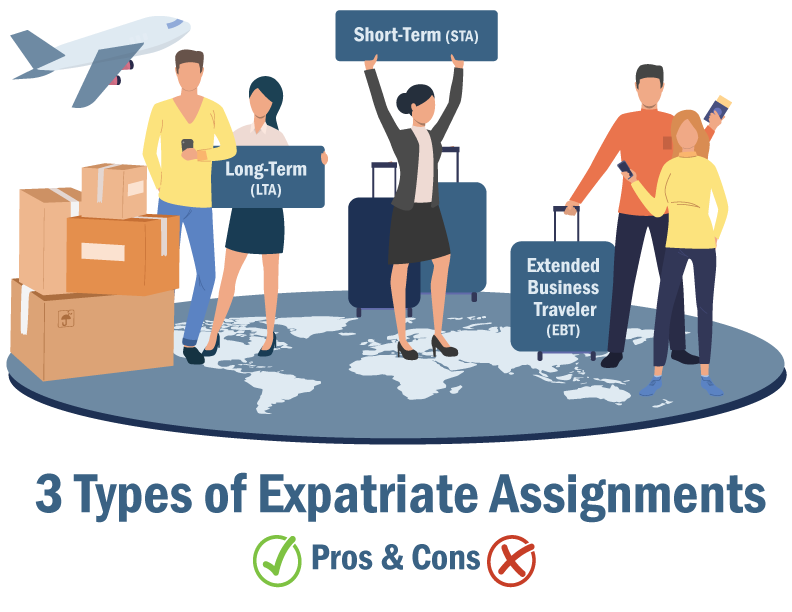
Pros and Cons of the 3 Types of Expatriate Assignments including Long Term, Short Term and Extended Business Traveler

Some companies may choose to use just one type of assignment or include multiple different options, depending on the employee and the position available. Either way, finding the best expat program for both your company and your employee will ensure both are successful long term.

Long-Term Expat Assignment (LTA)

A long-term assignment (LTA) refers to the relocation of an employee from their home country to work in a foreign country for an extended period, typically ranging from one to five years or more.  Unlike short-term assignments (STA’s), which might last only a few months, LTAs involve a deeper commitment and often require significant personal and professional adjustments for the expat employee.

During an LTA, the employee is expected to fully integrate into the local work environment, often taking on key roles that contribute to the company’s strategic goals in the host country.  This could include tasks like establishing new operations, leading a local team, implementing corporate strategies, or facilitating knowledge transfer between the home and host offices.

One of the most important things to note is that this type of assignment is not a permanent transfer; the employee intends to return to his or her home country after the long-term assignment is complete.

Long Term Assignment container shipment of household goods

Pros_Green-CheckmarkPros of a Long-Term Expat Assignment

LTAs provide a unique opportunity for employees to develop leadership skills in a global context.

By exposing them to different markets, cultures, and business practices, companies can groom future leaders who are adaptable, culturally aware, and capable of managing diverse teams. These global experiences are invaluable for shaping executives who can drive the company’s international strategy.

Expat employees often serve as a vital link between the headquarters and the host country’s office, ensuring that the company’s global strategies are effectively implemented at the local level. In the past, it was important to instill the culture of the parent company into the foreign entity and help drive revenue growth in the overseas location.

Today this still exists, but the opposite is also true. Overseas workers are being deployed to the parent country or other countries to gain experience, transfer knowledge, and run specific project-based work.


Con-Red-Checkmark Cons of a Long-Term Expat Assignment

One of the biggest challenges of long-term expatriate assignments is the potential strain on personal and family life. Relocating to a foreign country can disrupt children’s education, create challenges for a spouse’s career, and lead to feelings of isolation due to cultural differences and distance from extended family and friends.

Not all LTAs succeed. If an expat employee fails to adapt to the new environment or if personal issues arise, the assignment may need to be cut short, leading to significant costs. Costs are extremely high for expat assignments and many companies do not properly vet the individual being offered the assignment.

There are benefits available including candidate assessments and pre-decision services that are designed to assess the person’s ability to thrive in a “foreign” location and adapt culturally.  Additionally, many companies forego cultural and language training which is essential in providing a foundation for a successful transition.  Simple things like how to conduct a business meeting or learning the norms for handing out a business card are just some of the subtle social norms that will ensure success. Unfortunately, many companies choose not to or do not know the importance of this investment.

There are countless compliance requirements as well, and without the assistance of a relocation company, it can be hard to navigate. Many companies have chosen another route: short-term expat assignments.


Short-Term Expat Assignment (STA)

A short-term assignment (STA) typically refers to a temporary work arrangement where an employee is relocated to a foreign country for a limited period, usually ranging from a few months to a year.  Unlike long-term assignments (LTAs), which often involve significant life adjustments such as family relocation and long-term planning, STAs are more focused on specific projects, skill development, or filling immediate business needs.  STA’s can offer great flexibility and less commitment, but less fluidity and insurance.

Many companies will not allow the family to accompany the employee on these STAs but will provide other options such as more frequent trips home, furnished accommodations, per diems, travel allowances, etc.

Relocation management companies like WHR Global, can help manage short-term expatriates and provide the structure and benefits available to this group of assignees.

Short Term expat assignment with small shipment of items

Pros_Green-Checkmark Pros of a Short-Term Expat Assignment

The problems of dissatisfaction and homesickness became apparent with long-term moves, so short-term overseas engagements were developed as an alternative to pulling up roots and moving families across the globe for extended periods. Short-term assignments involve fewer personal and professional disruptions for employees. Family members often remain in the home country, minimizing the impact on schooling, careers, and social networks.

From your company’s perspective, a short duration generally costs less upfront, and it gives you more flexibility when developing a mobile, global workforce. Additionally, the consequences of individuals becoming “taxable” in the foreign location can be managed effectively, thus significantly decreasing the cost of the expat assignment.

Lastly, the pool of willing candidates inevitably increases as it is a short-term expat assignment, which reduces the potential impact on families and financial ramifications.

Con-Red-Checkmark Cons of a Short-Term Expat Assignment

The cons of short-term expatriate assignments revolve around demands to rotate a variety of personnel, which requires more planning and administrative time for everyone involved.

There is a trade-off between a series of short-term assignments versus a single long-term assignment.  What works for your company may not work well for others.

These assignments allow companies to leverage global talent efficiently while providing employees with international exposure and professional growth opportunities without the extended commitment of a permanent move.

Extended Business Traveler (EBT)

An Extended Business Traveler (EBT) program is a structured framework designed to manage employees who frequently travel internationally for business over extended periods, typically ranging from a few weeks to a few months.

Unlike traditional expatriate assignments, EBT programs cater to employees who remain officially based in their home country but spend significant time working in foreign locations. These programs are increasingly popular in global companies as they allow for flexibility and quick deployment of talent across borders without the need for full relocation.

Typically, these employees are not on a formal assignment; however, there are still potential tax and immigration considerations that need to be made when sending someone on these extended business trips.

Extended business traveler

Pro_Green-Checkmark Pros of an Extended Business Traveler

EBT programs allow companies to deploy talent quickly and efficiently across multiple locations without committing to long-term relocations. This flexibility is ideal for addressing short-term business needs, project launches, or client demands. For everyone involved, business traveling simply causes less disruption.

Your workforce has much more control over how they perform duties, and you do not have to permanently allocate resources to a foreign location.

Con-Red-Checkmark Cons of an Extended Business Traveler

Work visa requirements differ widely from country to country and can be impacted by the home and host locations involved.

In some instances, a worker may enter the country on a work permit waiver, but in other countries it may be illegal to perform a single work duty without having the proper work visas in place.

Conclusion

How companies manage expat assignments has changed in this post pandemic world. Ever changing immigration policies, unpredictable travel restrictions, and increased costs make managing these assignments more challenging than ever before.

Regardless of the assignment type that is considered, each type of expatriate assignment has its strengths and pitfalls. Every company needs to determine what is optimal for their workforce and the business needs requiring these assignments. Let the experts at WHR Global help guide your employees and company through these types of decisions and implementations.

Ready to learn about our move management services?

U.S. Domestic Relocation Cost Estimator

US Domestic Relocation Cost Estimator Icon

Interactive Repayment Agreement

Interactive Repayment Agreement Icon

Domestic Relocation Policy Designer

Domestic Relocation-Policy Designer icon

Relocation Benchmark Comparison

Relocation Benchmark Comparison icon

RFP – Relocation Request for Proposal Generator

Relocation Request for Proposal Generator

Relocating Employees to Switzerland? 10 Apps to Recommend.

Relocating Employees to Switzerland 10 Apps to Recommend

Is your organization relocating employees to Switzerland? HR, global mobility, and talent acquisition teams are expected to guide employees through this process and provide key resources. Some of the greatest resources an organization can provide to that employee are free or low-cost mobile phone apps. From Swiss customs to public transportation: here are 10 must-have apps you should recommend when relocating employees to Switzerland.

Transportation App for Employees Relocating to Switzerland

SBB

SBB stands for Schweizerische Bundesbahnen, which translates to Swiss Federal Railways. Consequently, as Switzerland’s largest transport company, SBB runs all major trains in the country. At the same time, SBB also provides links to the European high-speed network. Every day over a million passengers and more than two hundred thousand tonnes of freight travel on board more than ten thousand trains along the SBB rail network. Employees relocating to Switzerland can use the SBB Mobile app for public transportation all throughout the country. Relocating employees can also buy tickets from ticketing machines or at ticket offices in bus or train stations. Some buses in rural areas don’t have machines and ticket offices.

Payment App for Employees Relocating to Switzerland

TWINT

With TWINT, Switzerland’s payment app, employees relocating to Switzerland can make convenient and secure payments using their smartphones. The TWINT app makes it easy for expats to pay at store cash registers, in the supermarket, in the online shop, and when shopping in the farm shop – digitally and cashlessly.

Customs App for Employees Relocating to Switzerland

QuickZoll

QuickZoll is the official Swiss customs app for individuals. As a private individual, QuickZoll allows to employees relocating to Switzerland to independently declare goods for importation for their own use or as a gift and pay any applicable taxes and duties directly. In addition, the Swiss Customs app summarises all the important facts about entry to Switzerland briefly and concisely.

Public Safety App for Employees Relocating to Switzerland

Alertswiss

Alertswiss is the official, free mobile app which publishes all relevant information pertaining to precautions and behavior during disasters and emergencies in Switzerland. Although Switzerland is rarely affected by major disasters, it is good to know which dangers exist and which behaviour can protect employees relocating to Switzerland. Relocating employees can receive alerts, warnings, and information about their current location directly and constantly on their smartphones. 

Social App for Employees Relocating to Switzerland

InterNations

InterNations is a global community for people who live and work abroad. It’s the largest network of its kind, with around 4 million members in 420 cities worldwide. It offers networking and socializing both online and in person. Additionally, members can attend events, participate in forums, and receive tips and advice on expat life. In similar fashion, InterNations conducts an annual Expat Insider survey that ranks countries and cities. In 2023, Mexico was ranked the best place for expats.

Language Apps for Employees Relocating to Switzerland

Google Translate

Google Translate‘s mobile app is a must-have for expats in Switzerland. Chiefly, it is a multilingual neural machine translation service developed by Google to translate text, documents and websites from one language into another. Given that Switzerland has 4 national languages (German/Swiss German, French, Italian, and Romansh), employees relocating to Switzerland can look forward to translating many street signs, menus, and more.

Duolingo

Communication App for Employees Relocating to Switzerland

WhatsApp

Food Apps for Employees Relocating to Switzerland

Just Eat

Formerly known as Eat.ch, Just Eat is an excellent solution for employees in hotels, temporary housing, or transferees waiting for their kitchen supplies to be delivered by the moving company. Expats in Switzerland, accordingly, can order takeout or delivery from the Just Eat app from most cities in Switzerland, including Zürich, Geneva, Basel, Bern, Lausanne, and more. 

Too Good to Go

Due to its high cost of living, expats in Switzerland may have an affinity for the mobile app Too Good To Go. Too Good To Go is a free app that helps reduce food waste by allowing users to buy unsold food from restaurants, bakeries, and other businesses at a discount. In their 2022 annual impact report, Too Good To Go stated 2 million users open the app daily which saved 79 million meals. Even more, the app serves a greater purpose; It’s estimated nearly one-third of all food is wasted while 828 million people go hungry every day. By selling unsold food at discounted prices, businesses reduce excess waste and help communities reduce greenhouse gas emissions. 

Relocating Employees to the US? 10 Apps to Recommend.

Relocating employees to the US

Is your organization relocating employees to the US? HR, global mobility, and talent acquisition teams are expected to guide employees through this process and provide key resources. Some of the greatest resources an organization can provide to that employee are free or low-cost mobile phone apps. From language training to hotels, travel, and more: here are 10 must-have apps you should recommend when relocating employees to the US.

Social Apps for Employees Relocating to the US

InterNations

InterNations is a global community for people who live and work abroad. It’s the largest network of its kind, with around 4 million members in 420 cities worldwide. InterNations offers networking and socializing both online and in person. InterNations members can attend events, participate in forums, and receive tips and advice on expat life. InterNations also offers an Expat Insider survey that ranks countries and cities. In 2023, Mexico was ranked the best place for expats.

MeetUp

Meetup is a social networking site that allows people to find and join groups based on their interests. Meetups are informal meetings or get-togethers for people with similar interests. Meetups can be in-person or virtual, and can take place in places like cafés or parks. There are no membership fees to join Meetup, which makes it an excellent app for expats to build their new friend groups and social networks. 

Language App for Employees Relocating to the US

Duolingo

Communication App for Employees Relocating to the US

WhatsApp

Hotel & Travel App for Employees Relocating to the US

Booking.com

Headquartered in Amsterdam, Booking.com is an online travel agency that connects travelers with a wide variety of places to stay. The company was founded in Amsterdam in 1996 and has over 28 million accommodation listings. Booking.com offers discounts on hotels, flights, car rentals, taxis, and attractions. This is extremely useful for expats who are left for themselves to book hotel stays on short notice, or rental vehicles during their preview trip and temporary housing. 

Transportation Apps for Employees Relocating to the US

Uber & Uber Eats

When employees are relocating to the US, ride-hailing apps such as Uber are cost-effective solutions to getting to and from hotels, temporary housing, apartments, and homes. Furthermore, when expats are tired and jet-lagged from travel, they can order a plethora of food and other products on Uber Eats from the comfort of their hotel or temporary housing.

Lyft

Similar to Uber, Lyft provides ride-hailing, rental cars, and food delivery in the United States and Canada. Lyft offers a marketplace where drivers can be matched with riders through the Lyft app. Lyft also offers other transportation options, such as motorized scooters and bicycle-sharing. Lyft offers ride booking, payment processing, and car transportation services. Lyft can be a fantastic alternative when there is a spike in price, or lack of availability through Uber. 

Mental Health App for Employees Relocating to the US

Headspace

After death and divorce, it’s said that relocating is the third most stressful event in a person’s lifetime. Headspace is an app that offers guided meditations, courses, and mindfulness exercises on topics like stress, anxiety, and building resilience. The app aims to improve concentration and mood, and reduce anxiety. Offering hundreds of meditations, sleep sounds and music, focus music, and mood-boosting workouts, Headspace is an excellent mental health tool for expats who need to slow down and breathe. 

Home Goods App for Employees Relocating to the US

Amazon Prime

When expats need something delivered on short notice to a hotel, temporary housing, or unfurnished home, Amazon Prime can be an excellent and cost-effective solution. Some assignees may choose to bypass their household goods shipment altogether and purchase everything at their destination with a furnishings allowance. From TVs to furniture, cleaning supplies, and more, Amazon Prime is an excellent way for expats to furnish their new homes or deliver an essential item to temporary housing.

Self-Move App for Employees Relocating in the US

SimpleMove®

SimpleMove is a free, online platform developed by WHR Global. It can be used by: (1) employees relocating themselves within the US; (2) HR and talent acqusition teams who want to a self-move or lump sum solution for US relocations; or (3) established global mobility programs who want a cost-effective solutions for US relocations.

The largest financial benefit is a tax-free, cash-back rebate paid to the employee when they sell or purchase a home through a SimpleMove real estate agent. The rebate, paid after closing, is based on $5 USD per every $1,000 USD of the sale or purchase price. There is no cap on the rebate amount; For example, a $300,000 USD home sale or purchase will provide the relocating employee with a $1,500 USD rebate. This is in addition to accessing WHR Global’s network of moving companies, rental agents, temporary housing providers, mortgage lenders, and other helpful resources within the platform.

Relocating Employees Contact WHR Global Image

5 Corporate Relocation Trends to Keep an Eye On | Q4 2023

Employee Relocation Abstract globe focusing on North America illustration Ai generat

Here are 5 corporate relocation trends WHR Global is keeping an eye on for Q4 and beyond!

Global Housing Costs

Verdict: ↑ Varied ↓

Whether purchasing or renting around the world, global housing costs are expensive, but the past 12 months have been inconsistent. Within the corporate relocation industry, it’s important to keep an ear to the ground in key hubs of economic activity so organizations know when to adjust housing allowances, begin to offer mortgage support for homeowners, or improve the level of support. Below are examples of just a few key economic zones WHR is monitoring closely:


  • Germany: Year-over-year (YOY) property price decrease of -4%.
  • Japan: YOY property price increase of 5%.
  • Netherlands: YOY property price decrease of -9%.
  • Singapore: YOY property price increase of 7%.
  • Switzerland: YOY property price increase of 4%.
  • United Arab Emirates: YOY property price increase of 18%.

  • United States:
    • Homebuyers: average 30-year fixed mortgage rate increase from 6.02% (15-Sep-2022) to 7.18% (15-Sep-2023).
    • Boston, MA: median monthly rent increase of 3% YOY from $3,200 USD/month to $3,300 USD/month.
    • Los Angeles, CA: median monthly rent decrease of -8% YOY from $3,195 USD/month to $2,950 USD/month.
    • Houston, TX: median monthly rent remained stagnant with a 0% YOY difference from $1,794 USD/month to $1,795 USD/month.
    • New York, NY: median monthly rent increase of 5% YOY from $3,480 USD/month to $3,664 USD/month.
    • Miami, FL: median monthly rent decrease of -12% YOY from $3,800 USD/month to $3,350 USD/month.

Corporate Relocation in the Netherlands

Verdict: ↑ Trending Up ↑

Thanks to the European Union’s Right to Work and expat-friendly legislation such as the 30% facility, corporate relocation is positioned to trend upwards. For those unfamiliar, the Netherlands 30% facility allows employers to choose to pay their employees 30% of their annual salary tax-free (provided they meet certain baseline conditions). Expats also enjoy geopolitical stability, a consistently high quality of life, and expat-friendly banks such as ABN AMRO.

Netherlands Migration Statistics (2013-2022)

This chart shows immigration, emigration, and net immigration for the Netherlands from 2013-2022.

ESG Considerations in Corporate Relocation RFPs

Verdict: ↑ Trending Up ↑

Environmental Social Governance (ESG) is becoming commonplace in most corporate relocation RFPs. As organizations focus on sustainability and ethical practices, these factors play a pivotal role in their vendor selection. ESG compliance aligns with a company’s values, reflecting positively on its brand image.

Choosing corporate relocation services providers committed to these principles demonstrates a commitment to social and environmental responsibility, appealing to both employees and stakeholders. Organizations should seek out corporate relocation serivces providers who value committed action plans such as EcoVadis certifications and Science-Based Targets.

EcoVadis helps organizations manage ESG risk and compliance, meet corporate sustainability goals, and drive impact at scale by guiding the sustainability performance improvement of corporations and their supply chains.

Science-Based Targets help organizations lead the way to a zero-carbon economy, boost innovation and drive sustainable growth by setting ambitious, science-based emissions reduction targets. 

Air Shipments in Corporate Relocation

Verdict: ↓ Slightly Trending Down ↓

As detailed in our article, “ESG in Global Mobility: Turning the Tide on Air Shipments,” there are significant ESG advantages to reducing or eliminating air shipments. Air shipments have long been the go-to choice for international relocations and corporate moves due to their speed and efficiency. However, the environmental impact of air cargo emissions cannot be overlooked. As a greener alternative, sea container shipments present a compelling case for global mobility programs to transition towards more eco-friendly transportation modes.

To compare typical CO2 emissions between modes of transport (measured in grams of CO2 per metric ton of goods shipped per mile): flights emit 500 grams of CO2/metric ton of cargo per kilometer of transportation. However, ships emit only between 10 to 40 grams of CO2 per kilometer.

Communicate the difference in CO2 emissions between air, road, and sea shipments. Your employees may self-select a more eco-friendly option (if feasible), sending fewer items in their air shipments or not utilizing them at all. Or, instead of an LDN air shipment container which has a weight capacity of 750 lbs, consider reducing this entitlement to a D air shipment container which has a weight capacity of approximately 500 lbs.

Implement programs such as Discard & Donate to reduce shipment sizes, thereby reducing organizational costs and CO2 emissions. Consider offering a cash allowance in lieu of the air shipment, or eliminate the air shipment option altogether.

Global Mobility ESG

Inclusive Language in Employee Relocation Policies

Verdict: ↑ Trending Up ↑

As discussed during various regional relocation council meetings, including WiERC & CRC Chicago, corporations can have a large positive or negative impact on their employees by how their policy language is written. Writing a definition for family size, as an example, can have large downstream impacts if a family member feels excluded.

Here are some of the considerations employers should take into account when defining family size in their relocation policies:

  • Is your definition for family size consistent across all HR policies?
  • Is your relocation policy inclusive of same-sex relationships?
  • Should dependent children be limited to 18-years-old and younger? Or should dependent children include those up to 21-years-old if they’re still attending school?
  • Should your relocation policy include or exclude elderly dependents? If elderly dependents are included, this could have immigration complications.
Family moving home

Conclusion

In summary, the corporate relocation landscape is undergoing significant shifts, and WHR Global is diligently monitoring these trends for Q4 and beyond. The global housing market presents a complex and varied picture, emphasizing the need for organizations to remain adaptable and responsive in adjusting housing allowances and support mechanisms. The Netherlands emerges as a promising destination for corporate relocation, thanks to favorable legislation and expat-friendly policies. Additionally, the rise of Environmental Social Governance (ESG) considerations in relocation requests for proposals (RFPs) underscores the growing importance of sustainability and ethical practices. Finally, the focus on inclusive language in employee relocation policies highlights the impact that thoughtful policy design can have on employees’ well-being and satisfaction. As the corporate relocation landscape evolves, staying informed and embracing these trends will be crucial for organizations seeking to navigate this dynamic environment successfully.

Solving Immigration Challenges in the APAC Region | Case Study

Objective

Overcome Immigration Challenges by Providing the Right Partner to Our Clients & their Employees in the APAC Region.

Challenge

As a global Relocation Management Company (RMC), we provide our clients and their employees with many services, including immigration support. After the height of the Covid pandemic when APAC borders started reopening, a WHR Global (WHR) client was not happy with our current immigration partner. Changes in local authorities’ policies and requirements due to the pandemic were changing. Entry procedures were confusing. At times, there was a huge government backlog of cases due to border re-openings which resulted in delays and errors in government-issued documents. Some immigration providers were overwhelmed with the ever-changing immigration requirements.


When APAC borders began opening after the COVID lockdown, there were many challenges since every country had its own entry requirements. As an RMC, our #1 priority is always to take care of our clients and their employees, so WHR needed to have the right immigration partner in place to provide support. Thanks to our independent ownership and operation since 1994, WHR has the agility to pivot and utilize the best provider quickly.

Sean Thrun

Strategic Initiatives Manager, WHR Global


Based on weekly meetings WHR Client Services Managers were having with clients, we very quickly knew that our client’s needs and those of their employees were not being satisfactorily met by our current immigration partner. Red flags included the following issues:

Lack of Timely Responses & Not Accessible

Assignees were not receiving the assistance they needed, when they needed it from the immigration partner. At times, the employees were waiting several days just for an email response. Employees could not reach the immigration partner team members via phone. Employees were frustrated with the slow response, unavailability, and lack of
timely and regular updates.

The poor response caused delays since immigration requirements for some APAC countries were confusing & ever-changing as borders began opening. Clients cannot plan for the entire relocation process if there is any uncertainty in immigration timelines.

Timelines are crucial to relocate the employee and for the client to ascertain the employee’s official start date in the new location, and when to terminate employment in the current location. Some immigration processes were taking several weeks to complete even though the processes could have been completed in one week.

Administrative errors by the immigration partner caused additional delays. Immigration partner team members were not demonstrating the technical expertise needed to efficiently complete critical tasks.

Immigration partners provide a host of critically necessary support that our clients and their employees need including advising on key immigration changes, plus keeping employees legally compliant and stress-free so that employees can focus on business goals. Immigration services can include visa support, work authorization for foreign nationals, eligibility assessments, post-arrival registrations, residence permits, translation and legalization of documents, exit visas, re-entry permits, new entry, documentation requirements, and green cards for permanent transfers. Additionally, they provide work and study permission for family members, and documentation to prove family ties support.

Our global clients have a strong need to place skilled foreign nationals in roles throughout the APAC region, but it is important to be aware of regulations governing their foreign executives’ stay abroad, especially since documents required for a foreign national working in Asia vary from country to country. The right immigration partner will provide the needed support for success.

Additional Costs

Immigration delays can be costly, not just inconvenient. Consider a family of four relocating to another country and their immigration approval is delayed by 31 days. The chart below demonstrates this example. Their pack/load date, and their property handover date (rental or home sale), is fixed and cannot be changed. Now, instead of a 3-night hotel stay in their home country before their flight departs at $900 USD, they now have a 30-night stay at $6,000 USD. Meals for the 3-night stay would be $600 USD versus $6,000 USD for 30 days. Household goods (HHG) storage due to an immigration delay could equate to $2,000 USD. As shown in the chart below, the difference in organizational costs equates to an additional $12,500.

Costs for a Family of 4

Costs Without Immigration Delays
Costs & Times Due to Immigration Delays
Incremental Costs for Immigration Delays as Compared to No Immigration Delays
Immigration Approval
January 1
February 1 (31-day delay)
Pack & Load with Movers in Home Country (fixed date)
January 7
January 7
Property Handover Date in Home Country (fixed date)
January 9
January 9
Hotel in Home for Family of 4 in Home Country
3 Nights for $900 USD
30 nights for $6,000 USD
$5,100
Meals in Home Country
3 Days for $600 USD
30 days for $6,000 USD
$5,400
Flights
January 10
February 7
HHG Storage
N/A
30 days for $2,000 USD
$2,000
Temporary Housing in Host Country
45 Days
45 days
Secure Long-Term Housing in Host Country
February 24
March 24
HHG Delivery in Host Country
March 1
April 1
COSTS
$1,500
$14,000
$12,500

Solution

Sourced a New Immigration Partner

Immigration partners provide a host of critically necessary support that our clients and their employees need including advising on key immigration challenges, plus keeping employees legally compliant and stress-free so that employees can focus on business goals. Immigration services can include visa support, work authorization for foreign nationals, eligibility assessments, post-arrival registrations, residence permits, translation and legalization of documents, exit visas, re-entry permits, new entry, documentation requirements, and green cards for permanent transfers. Additionally, they provide work and study permission for family members, and documentation to prove family ties support.

Immigration partners provide a host of critically necessary support that our clients and their employees need including advising on key immigration changes, plus keeping employees legally compliant and stress-free so that employees can focus on business goals. Immigration services can include visa support, work authorization for foreign nationals, eligibility assessments, post-arrival registrations, residence permits, translation and legalization of documents, exit visas, re-entry permits, new entry, documentation requirements, and green cards for permanent transfers. Additionally, they provide work and study permission for family members, and documentation to prove family ties support.

Whenever possible, we use local providers. We also go direct as opposed to using brokered services. By going direct and local, we can pass on cost savings to our clients and provide customized solutions by eliminating the middleman.


Continuous Supplier Network Management

We also use key metrics to manage our network. By using real-time feedback via service evaluations from employees plus a score carding process, WHR can monitor existing providers to ensure they are meeting our service metric requirements. We provide that same feedback back to our providers, (on-time service, cost, etc.) so that providers can course correct quickly. Plus, providers know that superior performance drives more business their way. If service is below our standard, we are empowered to resolve it by engaging other providers, as we are not bound by any preexisting relationships.


“When there is a service issue, we first try to educate our supply partner to acknowledge the issue, identify the root cause, and brainstorm together for a solution to fix it and prevent a recurrence. If this still does not work, we have a wide network of suppliers to tap for a suitable partner that will meet or better still, surpass our client’s expectations.”

Rowen Wong

Client Services Manager, APAC Region, WHR Global

Benefits

The new immigration partner responds rapidly and makes each employee feel like they are a top priority. The partner acknowledges email receipts and provides an estimated time of when they will get back to employees. They also schedule regular calls with employees to walk through any outstanding documents, and they advise on the next steps. They provide employees with clear direction on what is needed & how quickly.

They offer 24/7 support, just like WHR does. Each employee is treated like a VIP. This is very important to WHR since we know that moving is one of the most stressful events in a person’s life. It’s our goal to help ease that stress so that employees can focus on their new roles sooner.

Less stress equates to better employee engagement and retention for our clients.

When immigration challenges arise, WHR has a partner that stays ahead of the curve.


“WHR takes great pride in its 24/7/365 availability and high client and employee satisfaction ratings. That’s why it’s so important that we partner with suppliers that match our principles. As a solely and independently owned organization since our inception with no ownership or affiliations with any providers, we have the freedom to act as a fiduciary to our clients and only choose the best suppliers for each move.”

Heather Hess

Director of Global Operations, WHR Global

whitepaper icon

Case Study – Zurich Temporary Housing

whitepaper icon

Case Study – Fortune 500 Workday Interface