WHR Global Releases Ask an Expert 2023 Allowances & Per Diems Benchmark Report

WHR Global Shapes Clients’ Policies to Ensure Allowances & Per Diems Are Competitive in the Market


Milwaukee, July 17, 2023 (GLOBE NEWSWIRE) — WHR Global (WHR), a leader in the global employee relocation industry, announced the release of its international 2023 Allowances & Per Diems Benchmark Report called “Ask an Expert!”

At WHR, our mission is to provide clients with superior relocation services, and to do so, we need to be in tune with the global cost of living. To accomplish this, we created the Ask an Expert 2023 Allowances & Per Diems Benchmark Report, a comprehensive guide to understanding the true cost of living, not just in one city, but in many cities worldwide.

“Drawing from my own personal experience as a former expat residing in Switzerland, and a former relocation coordinator, I bring a deep understanding of the challenges and intricacies of international relocation,” said Sean Thrun, Strategic Initiatives Manager at WHR. “This benchmark report and firsthand knowledge equips WHR with the ability to provide valuable insights and guidance to mobility teams, enabling them to navigate the complexities of global assignments more effectively.”

The Report includes 8.8 million price submissions from 11,000 cities, and prices benchmarked by country include rental prices for 1 & 3 bedrooms both inside and outside of city centers, common utilities costs per month, local transportation, and more. Understanding the ground realities of cost of living helps relocation teams create scalable solutions and helps businesses have more productive moves, making the transition for employees smoother than ever.

The Report allows businesses to “check the pulse” of their allowances and per diems, whether they choose to administer fixed amounts globally, or variable by location. If global mobility teams find that the allowances and per diems offered to their employees are lower than the average for that country, contact WHR today for a free consultation, including a breakdown of the benchmark report by city. 

Global mobility teams may use this Report, which covers 99 countries, to benchmark the following:

      • Monthly housing allowances for assignments & commuters,
      • Monthly utilities allowances for assignments & commuters,
      • Monthly transportation allowances for assignments & commuters, 
      • Transportation per diems for preview and home finding trips, and
      • Meal per diems for preview and home finding trips.

Whether you are a relocation manager or a business leader, investing in the Ask an Expert 2023 Allowances & Per Diems Benchmark Report today can help you make the most informed decisions for your relocation budget and employee benefits policies.

See more data and download the complete 2023 Allowances & Per Diems Benchmark Report “Ask an Expert” here.

The Ask an Expert 2023 Allowances & Per Diems Benchmark is intended for informational purposes only.

About WHR Global

WHR Global (WHR) is a private, client-driven global relocation management company distinguished by its best-in-class service delivery and cutting-edge, proprietary technology. WHR has offices in the United States, Switzerland, and Singapore. With its 100% client retention rate for the past decade, WHR continues to position itself as the trusted leader in global employee relocation. WHR lives by its vision and passion for Advancing Lives Forward® and Making the Complex Simple. To learn more about WHR, visit https://whrg.com/, or follow on LinkedIn or Twitter.


Media Contact: Sean Thrun, Strategic Initiatives Manager

[email protected]

+1-262-746-1314

ESG in Global Mobility: Turning the Tide on Air Shipments.

In an era where environmental, social, and corporate governance (ESG) is gaining significant traction, it is crucial for global mobility programs to evaluate and modify their transportation methods accordingly. Air shipments have long been the go-to choice for international relocations and corporate moves due to their speed and efficiency. However, the environmental impact of air cargo emissions cannot be overlooked. As a greener alternative, sea container shipments present a compelling case for global mobility programs to transition towards more eco-friendly transportation modes. In this article, we explore the advantages of sea container shipments and emphasize the need for a shift away from air shipments.

How Air Shipments Impact ESG in Global Mobility:

Air cargo plays a vital role in global trade and mobility due to its rapid delivery times and efficient logistics. However, the environmental repercussions are substantial. Aircraft emit greenhouse gases, including carbon dioxide, nitrous oxide, and particulate matter, contributing significantly to global warming and air pollution. The carbon footprint of air shipments is disproportionately high compared to other transportation modes, making it imperative for businesses and global mobility programs to seek sustainable alternatives.

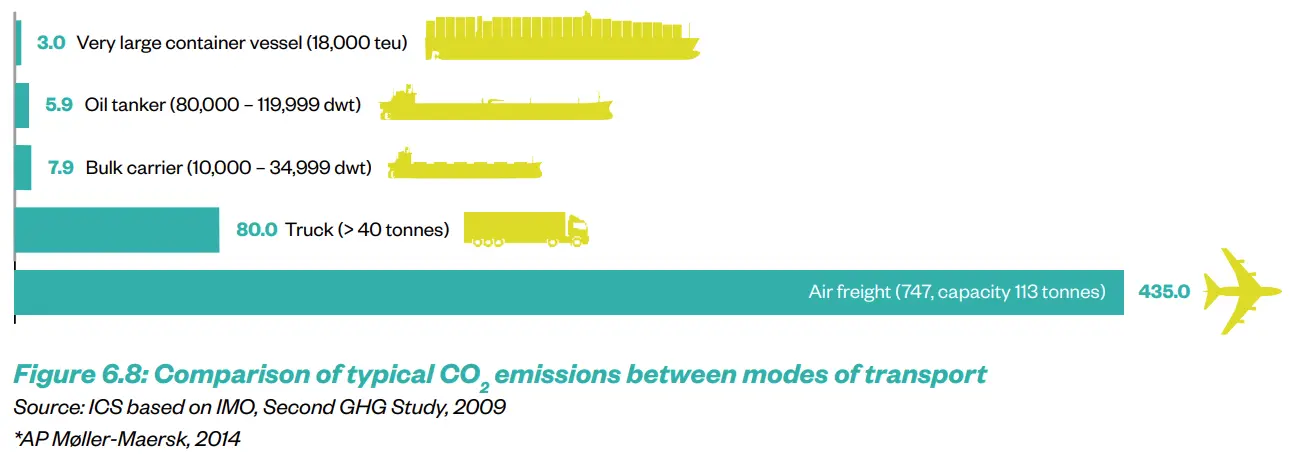
The image below is a comparison of typical CO2 emissions between modes of transport (measured in grams of CO2 per metric ton of goods shipped per mile). Other sources estimate that flights emit 500 grams of CO2/metric ton of cargo per kilometer of transportation. However, ships emit only between 10 to 40 grams of CO2 per kilometer.

The Advantages of Sea Container Shipments:

Reduced carbon footprint:

Sea container shipments emit significantly lower carbon dioxide per ton-mile compared to air shipments. Large cargo vessels have higher fuel efficiency and capacity, allowing them to transport goods in bulk, thus reducing per-unit emissions. This makes sea container shipments a more environmentally friendly option, particularly for long-distance relocations.

When paired with environmentally-friendly services such as Discard & Donate, global mobility programs take their ESG commitments to the next level. Not only does Discard & Donate reduce the cost of each household goods shipment for employers, it reduces the overall carbon footprint of air, sea, and ground shipments by eliminating the transportation of unneeded items and reducing the amount of packaging materials.

Cost-effectiveness:

Sea freight is generally more cost-effective than air transportation, especially for bulky or heavy shipments. By embracing sea container shipments, global mobility programs can potentially reduce shipping expenses, allowing for more flexible budget allocations or investments in sustainable practices.

Improved packaging and consolidation:

Sea container shipments necessitate careful packaging and consolidation due to the longer transit times involved. This requirement often results in more efficient use of space, reducing the overall volume of shipments. Effective consolidation reduces the number of containers needed and maximizes the use of vessel capacity, contributing to a more sustainable supply chain.

ESG-friendly modes for last-mile delivery:

While sea container shipments are not as fast as air shipments, various sustainable last-mile delivery options, such as rail or road transport, can be utilized to bridge the gap. This multimodal approach ensures that sustainability is maintained throughout the entire logistics process, from port to final destination.

Promoting circular economy practices:

The longer transit times of sea container shipments provide an opportunity for companies and individuals to adopt circular economy principles. By embracing sustainable packaging, reusing materials, and optimizing supply chains, global mobility programs can contribute to reducing waste and promoting responsible consumption practices.

Conclusion:

As the world continues to grapple with environmental challenges, it is crucial for global mobility programs to proactively shift away from air shipments and embrace ESG-friendly transportation alternatives. Sea container shipments provide numerous advantages in terms of reduced carbon emissions, cost-effectiveness, improved packaging practices, and opportunities for circular economy practices. Global mobility programs should consider the following steps to reduce their carbon footprint:

  1. Communicate the difference in CO2 emissions between air, road, and sea shipments. Your employees may self-select a more eco-friendly option (if feasible), sending fewer items in their air shipments or not utilizing them at all.
  2. Reduce the size of the air shipments offered. Instead of an LDN air shipment container which has a weight capacity of 750 lbs, consider reducing this entitlement to a D air shipment container which has a weight capacity of approximately 500 lbs.
  3. Implement programs such as Discard & Donate to reduce shipment sizes, thereby reducing organizational costs and CO2 emissions.
  4. Offer a cash allowance in lieu of the air shipment, or eliminate the air shipment option altogether.

By transitioning to sea container shipments, global mobility programs can play an active role in minimizing their environmental impact and contributing to a greener future. Embracing sustainable shipment modes is not only an ethical responsibility but also a business imperative that aligns with the growing global focus on environmental sustainability.

6 Ways to Align Global Mobility & Talent Acquisition

Has your organization strategically aligned your global mobility and talent acquisition stakeholders? Or do your teams feel siloed with different priorities and understandings? Read below to discover 6 ways to align global mobility and talent acquisition teams, including insights from Reda Belabed, GMS, a global mobility and immigration leader previously with Honeywell and General Electric, and WHR Global’s Strategic Initiatives Manager, Sean Thrun.

You’re not alone if you feel your global mobility and talent acquisition teams aren’t working towards the same objectives! Fortunately, there are several common-sense steps you can take to improve your talent mobility and ensure these stakeholders are working as a cohesive team.

When global mobility and talent acquisition teams are aligned, your highly specialized employees are hired quickly and compliantly.

1. Distribute “How To” Relocation Guides to your Global Mobility and Talent Acquisition Teams for Core Locations

Distribute “How To” guides to your talent acquisition and global mobility teams. These should be mission-critical things they must know for your company’s core locations, including immigration, tax, and recommended relocation support. For example:

      • Your company regularly hires executives to work in your Netherlands Global Center of Excellence. Are your teams applying for the Netherlands’ 30% ruling? Is your talent acquisition team responsible for ensuring each applicant meets the 30% ruling’s requirements before presenting the job offer? For example, your talent acquisition representative must ensure the candidate has specific expertise, is recruited greater than 150 km from the Netherlands border, and more.
      • Due to the highly specialized nature of your business, you are recruiting internal and external candidates for a position in the U.S. Is your talent acquisition team familiar with U.S. visa types, such as the L-1 visa for intracompany transfers, or the H-1B visa for specialty occupations? Your talent acquisition teams should know the basic requirements for each visa type before attempting to source foreign talent.
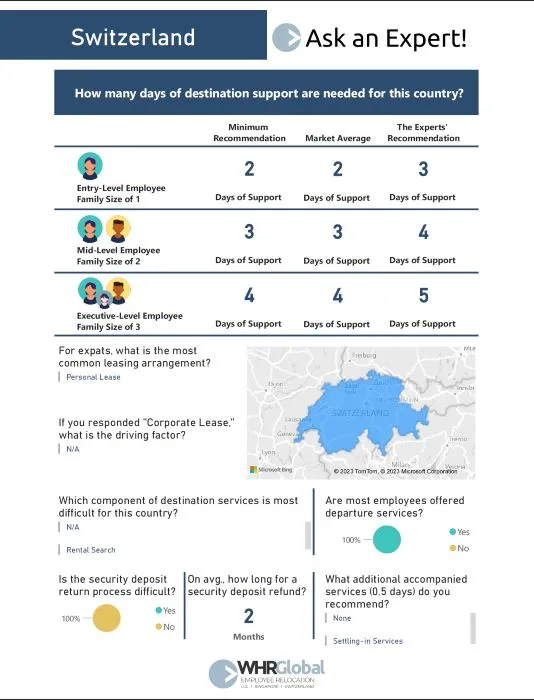
      • Your RMC should proactively guide the level of relocation support needed by country for your core locations. For example, this 2023 Destination Services Benchmark Report indicates the minimum, average, and recommended level of destination support by country, family size, and employee level. The report also indicates if leases should be personal or corporate, how long it takes to receive a security deposit return, and which components are most challenging.
WHR Global Ask an Expert Destination Services Benchmarking Switzerland

2. Review Talent Acquisition Metrics such as Time-To-Fill

Unfortunately, TA (talent acquisition) is not only measured based on the volume/quality of positions filled but mostly on the Time-To-Fill (TTF) which often widens critical gaps between the organizational needs, candidates’ experience and the tough reality of compliance.

I’ve implemented a cross-functional pre-assessment process for what I called “Immigration Hire-ability”, where permissible by law. Where it has been applied, I’m quite comfortable with the level of partnership it managed to increase between the two functions (and ultimately mitigate the risks of “bad hires”). In other places, Data Privacy regulations along with Fair-Employment Practices appeared to be hurdles to the implementation. There’s not a lot of flexibility when it comes to Labor and Employment, through Works Councils and the likes and it’s really been a challenge.

One of the plasters we have been focused on in these instances is increased (and repeated) training and education sessions with the recruiters to get them up-to-speed with “what they need to look out for/how to identify red flags” and review the overall communication strategy (up to offer accept), to enable all stakeholders to have a better understanding of the potential risks inherent to the hiring of Candidates on an immigration status and/or sponsorship requirements and responsibilities (incl. cost, timelines, immigration lifecycles, as well as talent management strategies).

I guess we’re all progressing but there’s still a long way before we can say we’re comfortable with the level of collaboration and partnership, with a 100% Candidate satisfaction, an improved TTF metric and a satisfactory pre-hire Immigration Compliance assessment.

Reda Belabed, GMS

Global Mobility & Immigration Leader, Previously at Honeywell & General Electric

3. Implement Pre-Acceptance Checkpoints to Increase Success Rates

As alluded to above, mobility programs can greatly increase assignment acceptance and success rates by implementing various pre-acceptance checkpoints.

      • Retain the services of a reputable tax firm. In addition to country briefings for assignees, they can provide invaluable guidance to talent acquisition teams. At a minimum, ensure your talent acquisition teams are familiar with the concepts of tax assistance, equalization, and totalization agreements. Provide pre-acceptance tax briefings to all foreign applicants.
      • For country-specific tax briefings, applicants should be aware of their options before accepting the position, as any misunderstandings can greatly increase the risk of a failed relocation or assignment. Assignees (especially those within executive or director-level positions) may have complicated investment portfolios of stocks, stock options, bonds, real estate holdings, precious metals such as gold, etc. The employee’s options will vary greatly depending on the location, citizenship(s), and relocation type (permanent transfer, long-term assignment, short-term assignment, commuter, business traveler). 
      • As mentioned above in step 2, build your own cross-functional pre-assessment process (a.k.a. immigration hire-ability guide) where the law permits. However, you should be cognizant of challenging jurisdictions such as the United States and European Union, as further detailed by Reda Belabed:

    Countries like the US where questions can be limited to “will you or in the future require sponsorship” and other EU countries where requesting personal information/data can be considered as PII and a hinderance to fair employment practices/discrimination at hiring. Geographies like the Middle East (GCC, in particular) are more open to these assessments.

    Authorities having a long history of foreign and diverse workforce tend to allow/promote the recourse to hireability checks based on sponsorship requirements but also advocating for more transparency in terms of “quotas”. Not that nationality quotas are something to condone, but the transparency around it helps the pre-determination of feasibility – instead of engaging with candidates through the offer stages only to discover it may not be possible. From an organizational standpoint, the process is quite transparent and streamlined.

    Reda Belabed, GMS

    Global Mobility & Immigration Leader, Previously at Honeywell & General Electric

    4. Pre-decision Calls through your Relocation Management Company (RMC)

    Your global mobility team and RMC may also choose to implement pre-decision calls. In relocation management, pre-decision calls ensure that the candidate understands the relocation package they’ll be receiving. However, they’re also an opportunity for your RMC to promote your company and benefits package and alleviate any concerns the employee or family may have.

    Pre-decision calls also prevent discrepancies or misunderstandings once the employee accepts the offer and begins the relocation process. For example, after the pre-decision call, the employee knows exactly which package they will receive, how much each relocation allowance will be, and more. Oftentimes, there is a disconnect between the relocation package quoted by a talent acquisition or HR business partner and the relocation package implemented by the RMC. This may boil down to human error or someone operating on an old/outdated policy. These discrepancies can be minimized when the RMC explains the relocation package pre-decision and implements the relocation package post-acceptance

    Align Global Mobility & Talent Acquisition

    5. Optimize Your HRIS for Maximum Talent Mobility

    Your organization can maximize talent mobility by creating custom fields, objects, and reporting in your HRIS (human resources information system). For example, in ADP, your organization can build and manage a talent pool of applicants willing to relocate for open positions. However, your organization shouldn’t overlook existing employees willing to relocate for an intracompany transfer. Existing employees should understand your products, services, and expectations, reducing hiring and training costs. 

    According to SHRM benchmarking, the average cost of hiring an executive is $28,329 USD. However, many employers estimate that the total cost to hire a new employee can be three to four times the position’s salary. This is a combination of hard costs, such as recruiters, and soft costs, such as the time it takes for department leaders and managers to support the hiring and training process.

    Instead of sourcing new candidates from scratch, speak with your IT department about adding custom fields and objects and reporting to your HRIS system. Then, existing employees can indicate in their HR profile if they’re willing to relocate for a new position. Within the custom reporting, you can also add filters to narrow your talent pool to high-performing employees who are willing to relocate, combined with past performance reviews already loaded in the HRIS.

    Online recruitment application and one day specialist search service concept with man finger on virtual digital interface with personal cards with rating

    6. Conduct Regular Training Sessions With Talent Acquisition Teams

    Regular training sessions ensure your talent acquisition teams have access to the same systems, resources, and responses to questions that are frequently asked by candidates pre and post-acceptance. Training sessions also provide new talent acquisition team members an opportunity to learn more about the mobility packages your employees are receiving and reinforce the message that all talent acquisition teams should follow the same standardized processes.

    Relocation management companies regularly arrange training sessions with talent acquisition teams and relevant stakeholders to improve talent mobility. These training sessions can include:

        • On-site training sessions from the relocation management company for mobility, TA, and HR teams. Depending on the size of your mobility program, your RMC may conduct these training sessions for free or just request your company to cover hotel and travel costs (depending on the distance and duration).
        • Virtual webinar-style training sessions from the RMC.
        • Country or region-specific training for your organization’s key locations, or locations presenting unique difficulties.
        • Insights from destination services providers (DSPs) and rental agents around market updates, cultural norms, and best practices.
        • Guidance from immigration firms on red flags, quotas, estimated timelines, minimum salaries, labor market testing requirements, and more.

    We have achieved significant success in transitioning regional structures to a centralized global mobility program by conducting regular training sessions with talent acquisition leaders. These sessions primarily focus on journey maps and crucial considerations throughout the process. By actively involving regional TA stakeholders in discussions about mobility benefits and desired outcomes, we have observed a noticeable increase in their willingness to adopt standardized processes.

    Sean Thrun

    Strategic Initiatives Manager, WHR Global


    In conclusion, aligning global mobility and talent acquisition teams is crucial for organizations to ensure efficient hiring and successful talent mobility. By distributing relocation guides, reviewing talent acquisition metrics, implementing pre-acceptance checkpoints, conducting pre-decision calls, optimizing HRIS systems, and conducting regular training sessions, organizations can foster collaboration and enhance the effectiveness of these teams. Achieving alignment leads to the swift and compliant hiring of specialized employees, reduces risks, improves time-to-fill metrics, and ultimately enhances overall candidate satisfaction and immigration compliance. Continued efforts and investment in aligning these teams will contribute to a more streamlined and successful talent acquisition process.

    Global Mobility: The Best Assignment Types for your Program

    Are you looking to expand your business globally and send employees on expatriate assignments? It’s important to choose the right type of assignment for your global mobility program. In this blog, we’ll explore the best types of expatriate assignments and how they can benefit your global mobility program. 

    global mobility assignment types

    Global Mobility Assignments Explained

    Finding the right person for an open position can be difficult. When you find that perfect fit, you’ll do what it takes to get them to their new location. However, relocating someone internationally can be a difficult task without proper guidance and support. Even if your global mobility program offers cost of living allowances, ships their household goods, or helps them find an amazing new home, expatriate assignments often go wrong over time.

    Housing, cultural adjustment, family adjustment, and a new work environment can all lead to poor productivity. This is especially true if the assignment takes someone far away from their loved ones for an extended period of time. Therefore, it’s important that you understand the advantages and disadvantages of the most common types of expatriate assignments: long-term, short-term, and typical business travel.

    Some global mobility programs choose to use just one type of assignment, or include multiple different options. This decision often depends on the employee and the position available. Either way, finding the best fit for both your company and your employee will ensure both are successful long term.

    What is a long-term expatriate assignment?

    There is no single definition of what constitutes a long-term expatriate assignment. However, a long-term expatriate assignment generally has a 12-month to 36-month duration. Some companies may define a long-term expatriate assignment as work that lasts a minimum of two years but not longer than five years. One of the most important things to note is that this type of assignment is not a permanent transfer; the employee intends to return to his or her home country after the long-term assignment is complete.

    Common relocation benefits provided to the employee on long-term assignment may include: immigration support, tax assistance, pre-assignment trip, household goods shipment(s), allowance payments, final move trip, temporary housing, cultural training, language training, spousal assistance, medical insurance, housing support, tuition reimbursement, and more. It’s best practice for the level of support offered to the employee to be commensurate with their experience, tenure, salary, and family size. However, the company may take geographical factors into consideration. For example, if the public school system is insufficient in the host country, assignees may receive tuition support for private schools. Due to the multi-year arrangement, it’s common for employees to secure a personal rental lease and bring their own furniture and furnishings from their home country. 

    Pros

    The benefits of expatriate work go both ways. You have the opportunity to dispatch your best talent to international partners and help them build and grow their international business. Additionally, your workers have the opportunity to expand their knowledge of different cultures and markets and enhance their careers with overseas experience.

    The specifics of each long-term assignment vary greatly depending on industry and location. In the past, it was important to instill the culture of the parent company into the foreign entity and help drive revenue growth in the overseas location. Today this still exists, but the opposite is also true. Overseas workers are being deployed to the parent country or other countries to gain experience, transfer knowledge, and run specific project-based work. How companies handle expatriate assignments are changing as global travel is now just as common as traveling within your own country.


    Cons

    Companies know that employee dissatisfaction with long-term expatriate assignments is a problem. The most striking example of employee dissatisfaction is when workers move their entire family overseas. It’s common for many staff to encounter buyer’s remorse as stress and unfamiliarity with new surroundings begin to affect loved ones.

    Costs are extremely high for expatriate assignments and many companies don’t properly vet the individual taking the assignment. They don’t test the person’s ability to thrive in a “foreign” location and adapt culturally. Additionally, many companies forego cultural and language training that is essential in providing a foundation for a successful transition. However, many companies choose not to or don’t know the importance of this investment.

    Consequently, increases in employee dissatisfaction and high costs with long-term assignments has led many companies to reevaluate their long-term policies. Many companies have chosen another route: short-term assignments.

    What is a short-term expatriate assignment?

    This type of expatriate assignment can last between three months to a full year. Similar to long-term assignments, each company defines short-term assignments differently. Because the employee plans on returning home after such a short amount of time, there are additional benefits that must be considered. Many companies will not allow the family to accompany the employee on these short-term assignments but will provide alternative benefits. These may include trips home up to twice per year, furnished accommodations, per diems, travel allowances, and more. Relocation management companies such as WHR Global manage short-term expatriates and provide the structure and benefits available to this group of assignees.

    Common relocation benefits provided to the employee on short-term assignment may include: immigration support, tax assistance, small shipment or excess baggage only, allowance payments, final move trip, temporary housing, medical insurance, housing support, and more. It’s best practice for the level of support offered to the employee to be commensurate with their experience, tenure, salary, and family size. However, due to the short nature of the assignment, the assignee’s family may stay in the host country which significantly reduces total costs. Due to the short duration, it’s common for employees to move into fully furnished temporary housing for the entire length of the assignment. 

    Pros

    The problems of dissatisfaction and homesickness became apparent with long-term moves. Therefore, short-term overseas engagements were developed as an alternative to pulling up roots and moving families across the globe for extended periods. From your company’s perspective, a short duration generally costs less upfront since the employee’s family generally stays in the home country. It also gives you more flexibility when developing workforce mobility. Additionally, the consequences of individuals becoming “taxable” in the foreign location can be managed effectively, thus significantly decreasing the cost of the assignment.

    Cons

    The cons of short-term expatriate assignments revolve around demands to rotate a variety of personnel, which requires more planning and administrative time for everyone involved. There is a trade-off between a series of short-term assignments versus a single long-term assignment. What works for your company may not work well for others.

    Unless utilized as a rotational development program, short term assignments may not be long enough to fulfill the business need. If the employee is opening a new location, launching a new product, or transferring organizational knowledge and skills, a long-term assignment may be needed to achieve all objectives. 

    What is an extended business traveler?

    These types of expatriate assignments can really rack up frequent flier miles. Typically, these employees are not on a formal assignment. However, there are still tax and immigration considerations when sending someone on extended business travel.

    Pros

    Business traveling simply causes less disruption for everyone involved. Your workforce has much more control over how they perform duties and you don’t have to permanently allocate resources to a foreign location.

    Extended business travel also allows you to draw from a larger talent pool of employees since some employees may outright decline a short or long-term assignment. Employees are naturally more likely to accept an extended business travel assignment due to the flexibility. Employees see their family more often, and extended business travel assignments may utilize a hybrid remote work setting when feasible.  

    Cons

    Work visa requirements differ widely from country to country and can be impacted by the home and host locations involved. In some instances a worker may enter into the country on a work permit waiver, but in other countries it may be illegal to perform a single work duty without having the proper work visas in place.

    Employees are also required to closely track their travel for tax and immigration purposes. Companies and employees may incur additional tax liabilities and unintended consequences if the employee overstays their welcome. 


    Watch Video

    For more info, check out WHR Global’s EMEA Client Services Manager, Jenny Elsby, speaking at the EuRA International Relocation event in Dublin, Ireland. “Assignment Types & Changes” on April 28th, 2023. 

    Strategies For Lowering Employee Relocation Expenses

    Since 1994, WHR has been helping its clients contain costs and lower relocation program expenses. Although there are many ways, below we share just three easy suggestions to lower organizational expenses. Explore three practical tips, from auditing your program to monitoring exceptions and staying ahead of industry trends. Discover how tailoring your approach to real-life experiences can minimize expenses while ensuring a smooth relocation for your employees.

    Jar of Change

    1. Audit Your Relocation Program

    Does your program reflect the real-life experiences of your relocating employees? Go through each step of the relocation process and analyze both quantitative and qualitative data. Look at the numbers from previous moves, but also survey employees who went through the relocation process and uncover which benefits were truly meaningful to them.

    It’s often said that relocating is the 3rd most stressful experience in a person’s lifetime, just after death and divorce. While it’s critical for employees to have a suite of relocation services to choose from, your company may not be in the financial position to provide certain ancillary benefits. It may be helpful for your global mobility team to stack rank which benefits are most critical to your employees, with the intention of cutting the least-critical services.

    Here is a sample stack ranking from most to least-important:

        • Immigration
        • Tax Consultation/Preparation Assistance
        • Tax Gross Up Assistance
        • Reimbursement of Final Move Expenses
        • Household Goods Shipment
        • Temporary Housing…
        • …Language Lessons
        • Cultural Training

    2. Monitor Policy Exceptions

    When the unexpected occurs during a relocation, you can bet it will impact the logistics throughout the rest of the process. These exceptions result in higher costs. The first step to minimizing exceptions and the impact to your bottom line is by designing a thoughtful and data-driven relocation program. The more your program reflects the actual experiences of your transferring employees, the better you can plan around exceptions. The program execution is equally important.

    WHR trains our Relocation Counselors to anticipate needs before they are requested, set expectations upfront, and regularly check in with transferees throughout the move. Should an exception be required, our Counselors review all possible alternatives first. Can a closing date be moved? Is there a more cost-efficient storage alternative? Can the cost be covered by a miscellaneous allowance?

    3. Stay on Top of Trends

    To find relocation cost savings, look at the dollars…and the pennies! With a little creativity and by staying current on what’s happening in the industry, you’d be surprised at the cost savings you can find.

    Consider home sale bonuses, for example. Ten years ago, companies would offer employees $10,000 as motivation to sell their homes quickly. This is not required in today’s real estate market since homes are selling quickly as demand greatly outweighs the supply of available inventory.

    Your Relocation Management Company can provide you with Benchmark studies and reporting identifying gaps or redundancies in your policy, as well as opportunities for savings.

    While a relocation benefit is a significant investment, there are ways to implement it thoughtfully in a way that keeps your employees happy and minimizes costs. Tailoring your program to the real-world experiences of your transferring employees, monitoring exceptions, and staying aware of industry trends ensures a smoother move experience for your employees and helps keep your expenses down.

    If you’re interested in learning more ways to cut costs, contact WHR Global.