
Buyer Value Option (BVO) vs Guaranteed Buyout (GBO) Home Sale Programs. How Do they Compare?

In the realm of corporate relocation, home sale assistance programs play a crucial role in easing the transition for employees and companies alike.

Among the relocation home sale programs, the most popular options are the Buyer Value Option (BVO) and the Guaranteed Buyout Option (GBO) programs.

Each option offering distinct advantages tailored to different needs, our blog will review:

BVO vs GBO Home Sale Benefit home sale with contract

Buyer Value Option
(BVO)

In a Buyer Value Option program (BVO), the employee is responsible for listing their home for sale, with marketing assistance from the Relocation Management Company (RMC). The employee must secure an outside buyer willing to purchase the home at a fair market value. A buyer value option program provides all the tax benefits to the employer and employee, but it depends on the employee securing an outside buyer. The employee is funded their equity, if the contract is deemed valid, based on the outside offer amount. The RMC closes the sale with the buyer at a future date. In a BVO home sale scenario, home appraisals are never ordered.

Buyer value options are a good way for an employee to oversee the entire process and ensure the best fit for their home. The risk of the home sale falling through falls onto the employee in this home sale option.

Guaranteed Buyout Option
(GBO)

What is a Guaranteed Buyout (GBO) program and how does it differ from a Buyer Value Option (BVO)?

Under a GBO program, the RMC orders two home appraisals and then averages the two to determine a guaranteed offer, with a fixed acceptance period. If the employee cannot sell their home on their own, the employer takes the home into inventory. The employer must maintain it until the company can resell it. This carries potential risks and additional costs for an employer.

A BVO home sale, on the other hand, minimizes this risk since the employer only purchases the home after the employee has secured an outside buyer. BVO and GBO home sale programs provide tax benefits to the employer and employee.

BVO Home Sale versus GBO Home Sale

When comparing the two, the choice between BVO and GBO depends largely on the company’s risk tolerance, market conditions, and the level of support they wish to provide to their employees.

BVO programs are cost-effective for companies but can place additional burdens on employees, making them more suitable for strong housing markets.

Conversely, GBO programs, while more expensive, offer greater assurance to employees, making them a preferred choice in uncertain markets or when a company prioritizes employee satisfaction and seamless relocations.
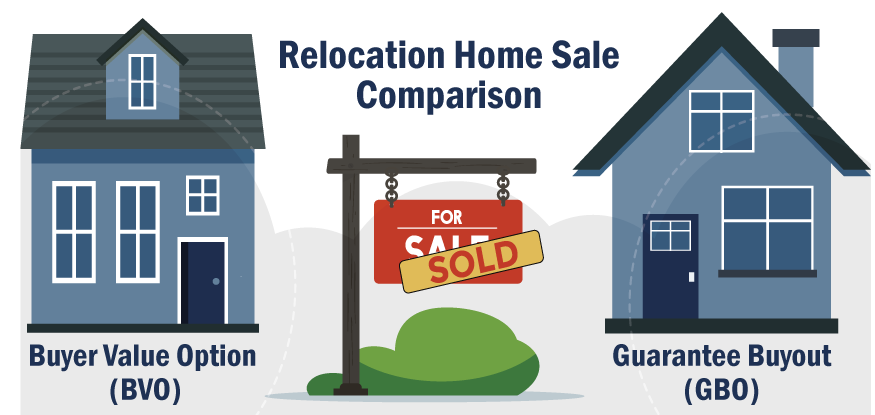
Relocation Home Sale Comparison reviews Buyer Value Option versus Guarantee Buyout Option

Here’s a side-by-side comparison of Buyer Value Option (BVO) and Guaranteed Buyout Option (GBO) home sale programs

Program Structure
Risk to Employee
Risk to Company
Home Sale Timeline
Employee Involvement
Financial Considerations
Market Impact
Flexibility
Appeal to Employees
Usage
Buyer Value Option (BVO)
Employee secures an outside buyer before the company purchases the home
Low risk if the home is sold quickly; however, the employee bears the risk if the market is slow
Lower financial risk since the company only purchases the home after an offer is secured
Typically, longer as the employee must find a buyer before the company purchase
High, as the employee is responsible for marketing and negotiating the sale of their home
Costs are generally lower for the company, but the process can be more stressful for the employee
The success of the BVO depends heavily on the current housing market
More flexible for companies that prefer to minimize upfront financial commitment
May be less attractive to employees due to potential delays and uncertainties
Preferred in stable or strong housing markets where homes are likely to sell quickly
Guaranteed Buyout Option (GBO)
Company provides a guaranteed buyout offer to the employee before listing
No risk to the employee as the company guarantees a buyout, regardless of market conditions
Higher financial risk for the company as they commit to buying the home regardless of market conditions
Generally faster, as the company buys the home directly if it doesn't sell within a set period
Lower, as the company takes over the home sale process after providing the buyout offer
Higher costs for the company due to the guaranteed purchase but provides more certainty and support for the employee
The GBO is less impacted by market conditions as the company assumes the risk
Less flexible due to the company’s financial commitment but provides more stability for employees
Generally, more appealing to employees due to the certainty and reduced personal risk
Often used in slower or volatile markets where securing a buyer may be difficult

Our countless years of BVO and GBO Home Sales experience can help you better navigate your journey.

This can include the range of tax implications, relocation variables, benefit payouts/amounts, and marketing work.

Let the experts at WHR Global help you with your BVO or GBO home sale relocation
and other global mobility program needs

WHR Global,a leader in global mobility, is an independent, full-service relocation management company with offices in the US, Switzerland, and Singapore. WHR strives to offer cost-effective relocation benefits without compromising empathy, ethics, or service

U.S. Domestic Relocation Cost Estimator

US Domestic Relocation Cost Estimator Icon

Interactive Repayment Agreement

Interactive Repayment Agreement Icon

Domestic Relocation Policy Designer

Domestic Relocation-Policy Designer icon

Relocation Benchmark Comparison

Relocation Benchmark Comparison icon

RFP – Relocation Request for Proposal Generator

Relocation Request for Proposal Generator

What is a Buyer Value Option (BVO) Home Sale Program?

A BVO home sale program is a program which is designed to help relocating employees sell their homes quickly and efficiently without the company taking ownership of the property.

According to WHR’s 2024 Global Mobility Benchmark, a BVO program remains one of the most competitive relocation offerings.

  • 60% of respondents offer home sale and/or purchase benefits.
    • Of those,
      • 59% offer BVOs to new hire non-executives
      • 78% offer BVOs to new hire executives
      • 67% offer BVOs to existing employee non-executives
      • 74% offer BVOs to existing employee executives

The best way to describe a BVO is in the context of
a traditional Guaranteed Buyout (GBO) program

Under a GBO, the relocation management company (RMC) orders two home appraisals and simply averages the two to determine a guaranteed offer.
As an example:

  • Appraiser A values a relocating employee’s home at $330,000
  • Appraiser B values the same home at $335,000
  • $332,500 is considered the “GBO”

The relocating employee then takes the offer of $332,500 and moves to their new location, unencumbered by their former home. In turn, the RMC sells the property on the
open market, and the employer is charged for all of the associated real estate expenses upon the conclusion of the sale.

The employer can treat the home sale costs as “business expenses,” so none of the expenses are considered income to the employee (for federal tax purposes).
This process is validated by the IRS in Revenue Ruling (2005-74), which specifically addresses this type of home sale program.

What is a Buyer Value Option (BVO)?

Essentially, BVO is very similar to a GBO, with the exception that with a BVO home sale program, no appraisals are completed. Instead, the buyout offer is based on a bona fide fair market offer received by the employee from a qualified third-party buyer. With BVO, the employee is responsible for listing their home for sale, and receives marketing assistance from the RMC.  

Once a contract is deemed valid, the RMC offers to buy the home from the employee at a price based on the outside sale price, and the employee is funded their equity based on this amount. The RMC will enter into a new listing agreement with the employee’s broker and proceed to close the transaction with the outside buyer while honoring all agreed terms and conditions. All home sale costs are treated in the same manner as with a GBO program.  

The BVO home sale program provides all the tax benefits to both the employer and employee. However, it is the responsibility of the employee to secure an outside buyer ready, willing, and able to purchase the property at a fair market value. 

Why should you offer your relocating employees a BVO?

    • Tax Savings: A properly structured BVO program that adheres to IRS requirements provides significant tax savings that benefit employees as well as employers.
    • Minimized Risk for Employees: Employees avoid the financial risk and stress of carrying two mortgages if they have to move before their home is sold.
    • Expedited Relocation: Employees can move to their new location more quickly, knowing that their home sale is being managed.
    • Cost Efficiency for Employers: Employers can manage relocation costs more effectively and help maintain employee productivity by reducing the stress and financial burden associated with home selling.

WHR Global provides the following
BVO support to help your employee
sell the home to an outside buyer:

    • Obtain two Broker Price Opinions (Broker Market Analyses)
    • Reconcile the two opinions of value
    • Suggest a listing price
    • Develop a comprehensive marketing strategy
    • Obtain pictures of the home
    • Provide tips to paint, declutter, etc.
    • Assist with Realtor selection
    • Obtain weekly feedback from Realtor
    • Assist in contract negotiation

Be aware: From a cost standpoint, when selling a home, the following expenditures are typical in a home sale transaction. 

When selling a home, there are several expenditures in a typical home sale transaction
  • Real Estate Commissions
  • Recording Fees
  • Transfer Taxes
  • Title Expenses
  • Notary
  • Escrow Fees
  • Seller Concessions
  • Repairs
  • Inspections
  • Miscellaneous

A Buyer Value Option home sale program is a valuable tool for companies looking to support their relocating employees. By assisting with the home sale process, companies can alleviate a significant source of stress for their employees, ensuring a smoother transition and enhancing overall job satisfaction.

For the company, this can translate into higher retention rates, more successful relocations, and a stronger ability to attract top talent. 

Ready to learn more about our move management services?

U.S. Domestic Relocation Cost Estimator

US Domestic Relocation Cost Estimator Icon

Interactive Repayment Agreement

Interactive Repayment Agreement Icon

Domestic Relocation Policy Designer

Domestic Relocation-Policy Designer icon

Relocation Benchmark Comparison

Relocation Benchmark Comparison icon

RFP – Relocation Request for Proposal Generator

Relocation Request for Proposal Generator

Providing Mortgage Support to Transferring Employees in Today’s Housing Market

As companies compete for talent, it’s important that your organization offers the right mortgage support to transferring employees. Whether it’s a new candidate or an existing employee, don’t lose talent because your organization isn’t offering the same or more support than your competitors. Given the current housing market conditions, it’s especially important to evaluate mortgage support so that contracts are not canceled.

According to a CNBC article, “Amid higher interest rates and a softening housing market, home buyers are continuing to back out of purchase contracts at an elevated rate. About 64,000 home-purchase agreements were canceled in August, according to a new report from Redfin. That’s equal to 15.2% of home contracts initiated during the month and similar to the 15.5% canceled in July. A year ago, the share was 12.1%.”

Rising interest rates could also have a negative impact on your transferees and their willingness or ability to relocate. When some employees are finally ready to go under contract and lock in their mortgage rates, the rates could be much higher than they were when they got pre-approved or when they received an accepted offer. This could also cause a canceled contract if the new rate is unaffordable.

“Data from the National Association of Realtors shows that housing affordability has plummeted by 29% over the last year – marking the steepest annual decline on record. The downturn is attributed to rapid mortgage rate and home price growth that has significantly quelled affordability. That’s because buyers of a median-priced home are now facing monthly mortgage payments that are more than $400 higher than they were in 2021,” according to a Business Insider article.

There are many ways that your organization can help transferring employees with mortgages. Below we’ve outlined a host of options that WHR Global (WHR) can facilitate through our preferred mortgage provider network.

Mortgage Interest Differential Assistance (MIDA)

MIDA helps employees when mortgage interest rates are high by easing the gap between current market rates and the lower rates that employees have on their current mortgage. This is not to be confused with a sliding scale (explained below), or a standard 1% loan origination/loan discount benefit because those benefits are applied regardless of the interest rate. The MIDA can be paid as a direct mortgage subsidy through the mortgage company. The MIDA benefit is determined by factoring the lower amount of either the transferee’s current outstanding loan balance (rounded up to the nearest $1,000) or the new mortgage amount. The difference between their current interest rate and the new (higher) mortgage interest rate, for similar products, (i.e., 30-year fixed rate to 30-year fixed rate), and multiplying the difference by the qualifying amount:

An Example from a WHR Supplier Partner, Rocket Mortgage

3.00% Old Interest Rate
5.00% New Interest Rate
2.00% Interest Rate Differential X $400,000 Current Loan Balance (Old Mortgage)
$8K is the yearly mortgage interest differential (.02 x $400K = $8K)

Payout Example
Year 1: $8K x 100% = $8K Total, or $666.66/month ($8K/12 = $666.66)

According to Rocket Mortgage, “The above is just an example. You can design the overall MIDA structure to what works best with your company culture and relocation program needs. For example, you can pay the full MIDA amount in year one only, adjust the percentages each year, or lengthen the term of the MIDA payment, etc.”

Interest-Based Mortgage Subsidy

This option slowly increases the transferee’s interest rate over time. Your organization pays the difference between the current note and the lower subsidized rate. Every year, the employee’s responsibility will increase by a 1% higher subsidized rate. This helps transferees transition into the higher mortgage payment. It can be applied toward principal and/or interest. If the subsidy is interest-based, your organization’s payout is dependent on the loan amount (which may be variable). To avoid this variable, some companies define a fixed dollar amount.

Dollar-Driven Mortgage Subsidy

When an employee is moving to a higher cost of living area (not due to higher interest rates), this option provides a pre-determined dollar amount based on the employee’s level. The amount can even be determined pre-move and pre-home selection. It can be applied 100% to principal and/or interest, based on the employer’s policy. It cannot exceed the monthly mortgage payment amount. Sometimes the subsidy is payable over a period of time that the employer chooses, 3 years, e.g. The payment is made directly to the mortgage company and applied against the employee’s mortgage payment.

Sliding Scale: Buying Down Points

A one-time expense used to permanently buy down the interest rate on a new home. This is especially helpful when interest rates are rising. Your organization will designate at what rate the scale starts and what mortgage discount points will be covered for each interval of the scale. Mortgage points are prepaid interest paid upfront in exchange for a lower interest rate and lower monthly payments.

Loan Discount Points (points) – Fees used to buy down the interest rate at the time of origination for the life of the loan. Points are calculated as a percentage of a loan amount. E.g., 1 point is 1% of the loan amount. One discount point does not equal a 1% reduction in interest rate. The value of a loan discount points is based on market conditions.

Example

Let’s say the current market interest rates on a 30-year fixed rate loan is 5.25%, the transferee would be eligible for 1 loan discount point based on the example sliding scale below based on $400K loan amount: 

  • 0% – 4.99% = 0 pts
  • 5% – 5.49% = 1 pts = $4K
  • 50% – 5.99% = 1.5 pts = $6K

Buying Down Points Example on a $200K loan

0 points (4.5% APR*)
1 point (4.25% APR*)
2 points (4% APR*)
Costs per Point(s)
$0
$2000
$4000
Employee's Monthly Payment
$1,013.37
$983.88
$954.83
Total Employee Savings on a 30-year loan
N/A
$10,616.40
$21,074.40

Other Possible Ways to Help the Transferee

$3K credit: Employer to cover the closing, or the credit could be used for escrow, or used to buy down the interest rate.

“It’s so important to provide the right benefits to transferees, including mortgage support. As an organization, you don’t want to lose a valuable employee or a potential new candidate to another company.”

Ben Koceja

Client Services Manager, WHR Global (WHR)

As a Relocation Management Company, WHR can provide your employees with our pre-approved network of mortgage providers.

Contact Us!

State of the Canadian Housing Market

Overvaluation and price acceleration continue to plague the Canadian housing market. According to the Canada Mortgage and Housing Corporation (CMHC), the housing market continues to have a high degree of vulnerability for the seventh consecutive year. The Housing Market Assessment (HMA) analyzes four main factors to determine vulnerability, or imbalances, in the housing market: overheating, price acceleration, overvaluation, and overbuilding.

Bob Dugan, Chief Economist with CMHC, states “our market assessment continues to show a high degree of vulnerability at the overall national level due to moderate levels of price acceleration and overvaluation existing together.”

Only weak signs of overbuilding and overheating were detected for Canada as a whole, with both indicators well below their threshold levels. However, the sales-to-listings ratio lies above the threshold of overheating and has for at least two quarters over the last three years.

What this means for individual markets

Victoria, Vancouver, and Toronto all scored high vulnerability in overvaluation, indicating that house prices are elevated compared to price levels supported by personal disposable income, population, interest rates, and other fundamentals. And with Amazon’s recent announcement to expand its Vancouver tech hub, housing prices could soar. Vancouver’s supply of available rentals has remained below 1 percent for three years in a row.

Calgary, Edmonton, Saskatoon, and Regina exhibited high evidence of overbuilding. In Edmonton, imbalances in ownership and rental markets were detected. The inventory of completed but unsold units also continued to drift around threshold level, while the apartment vacancy rate remained at threshold level.

For the fifth straight quarter, vulnerability in the Montreal housing market remained low. The level of personal disposable income, combined with the accelerated population growth among young adults, indicated that home prices have remained at justified levels. Still, given the marked tightening of supply and demand, the Montreal resale market is moving ever closer to overheating, which is putting a strong and steady pressure on prices.

“We just have our eye on [Montreal] to see whether price growth remains sustained and maybe spreads to more neighborhoods within Montreal,” said Dugan.

Choosing the Right Home Sale Benefit: BVO vs Direct Reimbursement

The Guaranteed Buyout (GBO) home sale program is typically the highest-level home sale benefit a company will offer its relocating employees, as it guarantees a home sale for employees based on appraisal value. However, the risk associated with this type of home sale, considering the employee’s home is then taken into inventory to be resold, may not be the best option for your relocation program. There are two additional home sale options that present less risk for your company—the Buyer Value Option (BVO) and Direct Reimbursement (DR).
<img alt="bvo">,<img alt="WHR Group">

So, what’s the difference between DR and BVO?


The BVO program is similar to a GBO in that you will be purchasing the home from your employee. However, with the BVO program, you will only purchase the employee’s home if they secure an outside buyer first. The great thing about the BVO program is that your company and employee will experience the same tax benefits that you would receive with the GBO. This means the home sale cost can be considered a business expense for your company as opposed to taxable income for the employee. This can occur because it is a three-part transaction, which includes your employee securing the buyer, the company purchasing the home from the employee for the agreed sales price, and then your company will sell the home to the outside buyer. Your employee won’t have to pay for any home sale costs or attend closing.


With a DR program, your employees will be responsible for selling their homes on their own. They will need to secure the buyer, as well as pay closing costs and commission fees up-front. You may then reimburse the employee all or part of these costs depending on your relocation policy. The IRS considers this type of reimbursement as taxable income, so, in order to cover that additional cost for your employee, you will need to gross-up the reimbursement.


                            Pros                             Cons
Direct Reimbursement > No risk of bringing homes into company inventory

> No tax benefits for your company

> Additional cost of gross-up

> Employee responsible for all costs up-front (closing costs, commission fees, inspections, etc.)

> Employee must attend closing

> Longer relocation process

Buyer Value Option

> Tax benefits for your company

> Employee not required to attend closing

> Broker Market Analysis completed by two qualified Real Estate Agents

> Home sale could fall through, resulting in home going into inventory


How do you choose which home sale benefit to offer your relocating employees?


It’s really all about what is going to work best for your employees, your company, and your bottom dollar. While it may seem easier and less costly to have your employees sell their homes on their own and reimburse them later, this isn’t necessarily the case. You could be spending an exponential amount more using DR because of tax and gross-up


A concern many companies have with the BVO program is they may still have to take homes into inventory. So, why then would you want to offer a BVO when there is still that possibility? While there is a chance a home could go into inventory if a sale falls through, it is minimal. The BVO process typically includes two qualified agents completing Broker Market Analysis reports, a comprehensive marketing strategy created by your relocation counselors, and a full review of all offers with your employees to make sure the offer is bona fide. Your employee’s relocation counselor will then follow the offer through to closing to ensure everything goes smoothly.


 When a corporation reimburses an employee for relocation expenses, the IRS treats that reimbursement as ordinary income, taxing it at the rate dictated by the employee’s tax bracket.


        Direct Reimbursement           Buyer Value Option
Home Sale Price $300,000 $300,000
Real Estate Commission (6%) $18,000 $18,000
Closing Costs (2%) $6,000 $6,000
TOTAL COST TO SELL HOME                                      $24,000                                      $24,000
Gross-Up Tax Assistance (40%) $9,600 $0
TOTAL COST FOR CLIENT                                     $33,600                                     $24,000
     
CLIENT SAVINGS                                              $0                                       $9,600


The average home costs $300,000, which means if you are offering just 10 employees a home sale benefit, you could be saving roughly $96,000 annually by using a relocation management company and offering a BVO program.