The Perfect Relocation Process

Do you know what WHR Group, USAA, Amazon, Apple, Nordstrom, and Ritz Carlton have in common? We’re known as THE leaders for providing the best service possible—regardless of industry. Whether it’s across client service-centric retailers or highly complicated processes and technology, being the best requires a deep understanding of people. An understanding that goes beyond client satisfaction and realizes loyalty is built on cultivating meaningful relationships. Which is why our mission is to provide the highest quality service to every client throughout the entirety of the relocation process.

domestic relocation

Our commitment to providing exceptional service on each and every move is forefront to the values we hold as a company. Our dedication to great service is exactly why we—and USAA, Amazon, Apple, Nordstrom, and the Ritz—use NPS® (Net Promoter Score®) as a key measurement tool across every aspect of what we do. When it comes to providing outstanding service, companies like us prefer a proactive approach to improving our service structure, and NPS provides the insight we need to be the very best there is.

The Role of NPS

While NPS is still fairly new from an awareness standpoint in the relocation industry, it is the best in terms of simplicity and as a measurement of brand loyalty. It is for these exact reasons why more than two-thirds of Fortune 1000 companies are now using NPS.

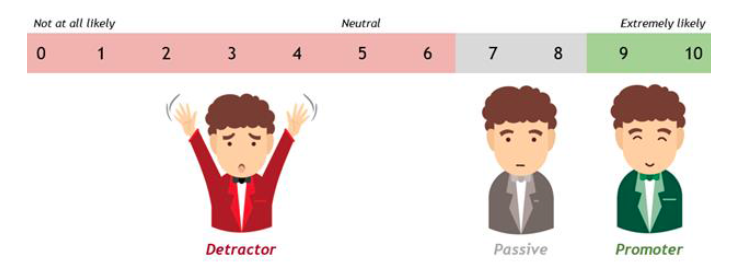
As a customer satisfaction benchmark, the score for NPS is calculated based on responses to a single question: “How likely are you to recommend WHR Group to a friend or colleague?” Based on a scale of 0 to 10, the responses can be categorized into three groups:

We calculate our NPS score by disregarding the passives and subtracting the percentage of detractors from the percentage of promoters. The objective being, of course, to achieve a high NPS score by having significantly more promoters than detractors. Depending on how our clients answered the NPS question, this score can range anywhere from -100 (all detractors) to +100 (all promoters).

The NPS question is just one of many that we ask our clients and transferees to answer. As we look at the full survey, we can easily connect the dots and pinpoint what service areas usually scored low when we had detractors. Not only are we able to pinpoint detractors based on these other questions, we can also ID problem areas in our workflow to proactively avoid potential issues ahead of time. 

How WHR Group Uses NPS

The design of NPS is to measure loyalty to our brand and by making NPS a key metric for our teams, we can focus solely on providing our customers with a positive experience at every interaction and maintaining a work culture that encourages exceptional performance while achieving the best results possible.

Here’s how this looks behind the scenes: Every Monday, our leadership team reviews the data and specific scenarios compiled by our surveys, which include the NPS question. Our leadership team looks for trends of detractors and come up with meaningful ways to help our team avoid those circumstances. For example, we know that filing a household goods claim due to broken or lost items increases the chance of people becoming a detractor exponentially. For this reason, we use claim rates as a major factor to select vendors for each move. Additionally, and as a result of our independence, we choose our vendors based only in our client’s best interest and regardless of vendor affiliation.

Because NPS doesn’t share the whole of the problem, just the effects of underlying root causes, when someone is a detractor, we look at everything that has happened throughout the relocation process. In doing so, we might find that they are a detractor simply because they are losing money on their home. While we may not necessarily be able to do anything about it, we CAN adjust our process to be more proactive in talking to transferees about possible issues up front in order to better prepare them for the reality of their situation.

Here’s why we do this: Our customers are incredibly loyal and with 100% client retention over the last decade, we want our client’s transferees to be loyal to them. NPS helps us promote loyalty within our client’s organization and highlight why relocation is an asset to both the organization and the employees themselves. Most of all, we use NPS because if your employee has a great relocation experience and their coworker also needs to relocate, it’s likely that one great experience will lead to another for greater acceptance of relocation jobs and employee retention.


If you’re ready to get the service your top talent deserves during their move, reach out. We’re happy to share some of our favorite success stories and walk you through our process.

Three Strategies for Lowering Relocation Expenses

In a recent post, we looked at how relocation pricing works and how to positively impact your relocation spend and budget. In this post, we continue our discussion of relocation pricing, focusing on three ways you can lower your relocation expenses.

domestic relocation

Audit Your Relocation Program

Before you can start making decisions on how to reduce costs, you have to understand your current program – what you offer, what you don’t, and most importantly how your program reflects the real-life experiences of your relocating employees. That means going through each step of the relocation process and analyzing both quantitative and qualitative data; not only looking at the numbers from your previous moves, but also surveying your employees who went through the relocation process and uncovering what benefits were truly meaningful to them. For example:

  • Which benefits did they use the most, and how were they used? For example, if your program allowed for one house hunting trip, would a second trip have been helpful?
  • Which benefits did they use the least? Is that because they truly didn’t find it helpful, or because they didn’t understand the policy or its value?
  • What changes to the program would they like to see? Why?

Even if budgetary limitations prevent you from following through on every request, fully understanding the process can help you make sure you’re providing the right benefits and eliminating the ones that aren’t providing value. By making sure the policies are clean from the start, you’re laying the foundation for a time- and cost-efficient relocation.


Stay on Top of Exceptions

One thing every relocation has in common is the need for precise timing and logistics: When the unexpected occurs during a relocation, you can bet it will impact the logistics throughout the rest of the process. The closing on a new home gets delayed? That means you’ll need to find temporary housing for the transferring employee’s family and extend their storage arrangements. These exceptions result in higher costs. In fact, two-thirds of moving exceptions stem from temporary housing.

The first step to minimizing exceptions and their impact to your bottom line is by designing a thoughtful and data-driven relocation program. The more your program reflects the lived experiences of your transferring employees, the better you’re able to plan around the exceptions. However, the execution of the program is equally as important. Which is why we train our Relocation Counselors to anticipate needs before they are requested, level-set expectations upfront, and regularly check in with transferees throughout the move. Should an exception be required, our Counselors review all possible alternatives first—Can a closing date be moved? Is there a more cost-efficient storage alternative? Can the cost be covered by a miscellaneous allowance?—to make sure the impact on the relocation budget is minimal.


Staying on Top of the Trends

To find relocation cost savings, you don’t always want to look at the dollars – you want to look at the pennies. When you move 100 people per year, there is a lot you can’t change. Real estate prices are what they are and moving fees are largely consistent among service providers. But with a little creativity and by staying current on what’s happening in the industry, you’d be surprised what savings you can find.

One of our favorite examples is flat screen TVs. Fifteen years ago, when flat-screens were first in demand, they were both expensive and incredibly fragile. Moving companies would build custom crates to transport at a cost of nearly $500 each.

And what’s a little crazy is…that’s still the process today. Even though flat-screens have evolved since the early 2000s, are far less expensive, more durable, and most people have 3 or 4 per house. You no longer need a custom box to transport them. A blanket will do just fine. If you take that savings of $2,000 per move and multiply it by the number of moves you have per year, suddenly we’re talking about a significant savings.

Or look at home sale bonuses. Ten years ago, companies would offer $10,000 bonuses to employees to motivate them to sell their homes quickly. That benefit is still prevalent today, even though homes are currently on the market on average only 78-days.

Through the use of regular benchmark studies and clear and consistent reporting, we’re able to identify any gaps and redundancies in your policy as well as opportunities for savings. Savings that can then be used to optimize your policy for a better relocation experience for your employees.

While a relocation benefit is a significant investment in your employees and your business, there are ways to implement it thoughtfully in a way that keeps your employees happy and minimizes costs. Tailoring your program to the real-world experiences of your transferring employees, keeping on top of the relocation process and staying aware of industry trends not only make for a smoother move experience for your employees, but it helps keep your expenses down.

Let’s Talk Pricing

When looking to reduce how much you spend on moving your employees, the first question you might want to ask a relocation partner might be, “How much are your fees?” While that’s a reasonable place to start, if your top concern is making a significant and meaningful impact to your company’s relocation budget, what you need to be asking is, “What’s the right policy for my company and employees?”

domestic relocation

The Truth About Fees

There are two things every cost-conscious human resources professional needs to understand about relocation company fees: they’re generally consistent across providers and they tend to be the smallest portion of your relocation budget.

Because the truth is, when you start comparing relocation companies, you’ll find that there isn’t a ton of variation in the fees they charge. Here’s why:

Relocation is a mature industry with streamlined pricing. Most reputable relocation firms have been in the business since its inception, which leads to little difference in operational cost from one company to another. That translates to tighter margins and little room for discounts.

Prices are largely fixed. Every relocation firm works with third-party real estate professionals, movers, and packers – all of whom charge roughly the same for their services. Everyone’s household goods moving process requires the same number of boxes, trucks, and boats across the regions they serve. Because these costs are flat, so are the fees across the industry.

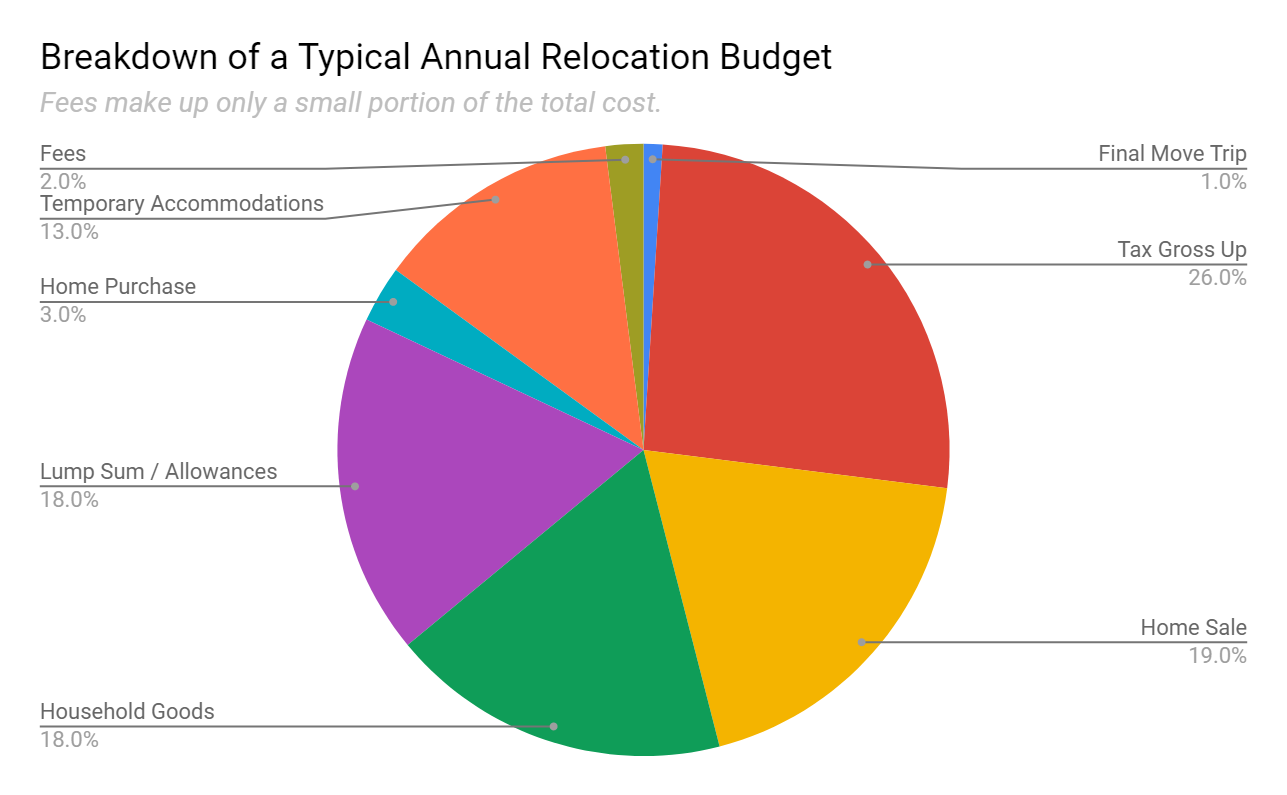
Not only are fees pretty consistent from company to company, they’re also a fairly small slice of a traditional relocation budget. Consider the following chart:

The vast majority of a relocation program’s budget is spent on housing, moving and storing household goods, and taxes. Again, there’s very little to make up in fees.

The Real Savings Are in the Policy

The best way to realize relocation program savings is by creating a policy suited to your company’s unique needs and its people. The moving industry will always be people-centric and largely depend on human intervention to get your employees from point A to point B. Which is why WHR Group starts every relationship by thoroughly understanding each client’s relocation priorities and applying technology thoughtfully. This allows us to create exceptional and compliant programs.

We begin with a clear and accurate understanding of how each of our client’s relocation dollars are spent. Our in-house, proprietary technology is able to analyze the current program against real-world relocation experiences and identify opportunities for potential savings. Whether it’s outdated policies, unnecessary gross-up, or too many exceptions; we tailor the program and our support to actual usage. Allowing our clients to maximize efficiency while minimizing costs.

Better still, while we’re customizing your plan to your company, we can also gauge its competitiveness. Our benchmark reporting stacks your program against your competitors using in-house client and non-client data, so you can see not only any gaps in offerings but also if you’re overspending by providing benefits your industry doesn’t value.


Perhaps the best recommendation for making sure you’re not overpaying for your relocation program is to partner with a company that’s focused exclusively on your specific budget and needs. We’d be happy to talk with you about your program and how we can tailor it to really make it work for you.

Putting Our Core Values to Work

The relocation industry has and continues to change. Mergers and buyouts are commonplace with relocation firms regularly getting bought and sold to broaden the parent company’s capabilities or boost their bottom line. This isn’t necessarily good or bad – it’s just the nature of our industry, and business, in today’s world.

But it reminds us of our core values and the way we live them out. As a family-owned and -operated firm, we feel that core values define who you are, both as a person and as a company. We also believe the relationship with our customers is sacred, and when you start making decisions about your future without considering their impacts, you can put your relationships in jeopardy.

domestic relocation

Our relationships; with our clients, our employees, and the communities in which we live and work, are why we started this company and continue to have so much fun doing what we do. The unique way we’ve structured our company allows us to honor and uphold our core values:

  • The freedom to keep our clients’ needs first. We always want to maintain the ability to run our business as we see fit. We know the psychology and logistics of moving and because of this invest heavily in our service model. This includes our two-person counselor teams. We know from experience that two-person teams provide better attention to detail, communication, and a superior client experience. For us, this investment is worth the cost. Our commitment to our independence means we can always keep to our core values and put your relocation needs above all else, no matter what.
  • Stability. Because we manage our own company, our business can grow organically. We base our decisions for the future on quantitative, real-life relocation data as well as the qualitative feedback our clients offer us. We’ve built our business with trustworthiness, hard work, and empathy, both for the client and the transferring employee. When our clients turn to us, they know exactly what they’re getting, and they’ve come to rely on us for more than two decades.
  • Trust. When we say our client relationships mean everything to us, we mean it. Our first clients from back in 1994 are still our clients today because they know what we stand for and our commitment to them. That trust has allowed us to expand globally, invest in technology, and reinvest in the people who’ve made us successful. Our clients know implicitly that we’d never take shortcuts with their relocation or bring on people who have other ideas on how we should serve our customers.

Our company’s structure is specific, purposeful – and it works. It’s the reason our clients trust us with their most sensitive information and the critically important job of relocating their most valuable employees. Being a family company lets us put our core values to work – and at the end of the day, it’s not a relocation company’s location or size that’s at the heart of its business, but how much they care for their clients.

Retaining Employees Through Empathy: The WHR Group Approach

Ask any human resources professional and they’ll tell you: getting the right people in the right jobs is only half the battle. The other half? Retaining them. Given the current era of low unemployment and the increasing cost of replacing employees (almost twice the cost of single employee’s annual salary!) employers are finding it harder to fill their open positions and investing more than ever in recruiting. That’s why we’re so focused on making sure every moment of your employee’s relocation experience is top-notch—because their family, community, and home are far more poignant priorities than ping pong tables and Friday Jean Days.

domestic relocation

We know this from our 2018 benchmark study on global mobility and corporate culture where we learned that 46% of employers use relocation as a tool for retention. Relocating the right people to the right places doesn’t only help companies reach business objectives either. When used as part of a forward-looking talent management program, it can spur career development and help keep employees engaged. But for this to happen, relocations need to be properly executed, with care and empathy. Let’s take a closer look at how relocation, when done right, can help retention.

Happiness Equals Productivity

If you’ve suspected that happiness promotes workplace productivity, the data is right there with you! Gallup reported that companies with engaged employees outperform their unengaged counterparts by more than 140%. Similarly, a 2014 study of more than 700 people across four different experiments confirmed that happier people are more productive. It’s proven time and time again—happy employees = happy customers = more revenue.

And because of how personal and intimate a relocation is for your employees, the impact can go far deeper. If your employees are worrying about their home not selling or the logistics of moving, they’re not focused on their work. If they feel ignored or are fighting over a misunderstanding about a reimbursement, they might even feel far less engaged than before the promotion that precipitated the move.

That’s why it’s imperative your relocation program partner is doing everything they can to ensure each of your employee’s needs are being tended to with care. At WHR Group, everything we do revolves around making your employees’ moves streamlined with high-touch service, support, and empathy.

Relocation with Empathy

Anytime someone relocates for work, there’s many sensitive factors that pop up. For example, maybe their house isn’t selling for as much as they anticipated, or their kids don’t want to leave their school, or their spouse is worried about finding employment in a new city. All of these are vital concerns and if left unaddressed, could significantly undercut the promotion and relocation benefits they received. This is why it’s critical your employees and their families are treated with empathy and responsiveness.

Our service model was designed to address the top concerns families have during a relocation before they become problems. We also train every professional who works with relocating employees as “counselors.” Their role and focus is to manage not only the timing and details of the move itself but also help each employee through any personal issues and concerns accompanying the move. Our goal is to make each employee as comfortable with the move as possible, so they can do their best work and know their company is concerned about their well-being.

Tailoring Each Move to the Needs of the Employee

Experienced counselors are only part of the story when it comes to focusing on the needs of your relocating employees. WHR Group also customizes the tactical aspects of each move to the needs of each employee, while also working within the parameters of your benefit program.

We do this because no two relocations are the same. A well-established family of five could require a full-service van line on the day of the move, while a single college graduate might be better served with a U-Haul or POD, which requires fewer resources and can get to the destination faster. Using our best-in-class proprietary technology, our experienced counselors easily and quickly adapt to the needs of each employee while still working within your company’s pre-arranged benefit budget and requirements. Giving us more time to provide high-touch, one-on-one, and caring support to your employee and their family’s immediate needs. It’s how we create a flexible, employee-centric relocation experience that can meet real people when they really need it.

For a relocation program to boost employee productivity and positive feelings about the organization, it needs to be administered with care and forethought. It’s why we value hard work, empathy, proactiveness, and trustworthiness in everything we do and from everyone we employ. We invite you to learn more about our high-tech, high-touch practice and how we can help your relocating employees feel great about their move.

Employee Relocation Toolbox

Is Your Relocation Technology “Just Right?”

When you’ve been in the relocation business for more than two decades, you learn that you need to be a little like Goldilocks when incorporating technology into a relocation program. Too little technology, and your clients struggle with the logistics of moving their employees. Too much technology, and they end up wasting time figuring out how to make it work – and start to feel like they aren’t a priority.

We believe that when it comes to something as important and ultimately as personal as relocating, technology should support the relationship, not replace the relationship. All of us at the WHR Group are committed to saving our clients time, lowering their costs, and increasing their happiness – and our technology plays a big part in accomplishing these goals. That’s why we built our technology in-house, to adhere to the unique needs of our clients.

Building the Program Within the Technology

When bringing technology into a relocation program, the worst thing you can do is try to fit the technology into the program. You end up with limited functionality, customization, and having to settle for half-measures and workarounds. Or, worse, you have to try to adjust your internal processes to accommodate the limitations of the tech.

We take a different approach. During implementation, we talk with you about every last detail of your program and policies; including best practices, benefit recommendations, and your preferences in how you want to run and analyze your program. We then build all of these details directly into the technology, so that when you and your relocating employee go to use it, it’s already working within the parameters of your exact policy.

For example, consider the specific timing requirements for a relocation. For a relocation to be time-efficient and cost-effective, the timing of the individual stages – from the sale of a residence to property storage to moving day – has to be precise (if moving day is a Wednesday, you can’t have the trucks show up on Tuesday or, worse, on Friday). The challenge lies in controlling for the myriad policy possibilities: Every policy is different in terms of timing, and an out-of-the-box solution won’t be able to address your policy’s exact needs. The answer lies in crafting a client-focused and customizable solution: We build technology around your specific relocation program details, taking into account the timing details of the benefits you select and creating a timeline accordingly. By creating proprietary tech that responds to your specific needs, our technology serves as an extension of our personal client relationships.

Another example might revolve around relocation data reporting. Let’s say you decide you want your data split out by cost centers instead of location. In our initial discussion, we make sure we understand exactly how your reporting data should be formatted and then set up the tech accordingly. That way you’re not wasting time trying to reformat the data or adjust your own internal systems to accommodate us.

And these aren’t the only ways our technology can facilitate both the relocation and your needs:

  • Project management. The predictive workflow system is completely customizable, tracking over 3,000 data points and 300 critical events in the relocation process
  • Data security and compliance. Our implementation of the over 260 controls outlined by NIST SP 800-53 proves our dedication to data security and compliance.
  • Expense management. Many companies allow you to submit expenses through a mobile app. But far fewer take the important next step: comparing a submitted receipt against the predetermined policy benefit and automatically alerting a relocation counselor if there’s a misunderstanding.
  • Invoicing. Our program automatically submits invoices on your preferred schedule and in a way that works with your internal systems (down to the order of columns within Microsoft Excel), helping to increase accuracy and efficiency.

Ultimately, technology is an extension of the company that uses it. At the WHR Group, we take a holistic, personal approach to our client relationships. Whether it’s through our two-person counseling teams, our no-voicemail policy, or our commitment to prompt issue resolution – we make sure you can feel care and support through every interaction.


Want to take that technology for a spin? Map out how much a relocation might cost with our free Domestic Relocation Cost Estimator, or explore what your company’s relocation policy might look like through our free Domestic Relocation Policy Designer.